| PLAYERS | TIME | DESIGNER | ARTIST | PUBLISHER |
|---|---|---|---|---|
| 1-4 | 60 mins | Matt Leacock Matteo Menapace | Mads Berg | CMYK |

METHOD
Climate change is the new virus!
That is to say, Matt Leacock is back with another co-op game where you team up to save the world. But instead of collecting city cards to take down four nasty little illnesses, you’ll be playing a heck of a lot more cards to fight back climate change one project at a time.
You have no more than six rounds to reduce the carbon footprint of your World Faction, all while fending off a horrible deck of Crisis cards that will slowly, and inevitably, raise the global temperture, triggering cataclysmic events that will overwhelm you.
And hopefully, you’ll learn some important things along the way.
POINTS OF INTEREST
Okay, so let’s get this out of the way now; this is a game that has been, and always will be, compared to PANDEMIC. It pretty much could have been another of the many spin offs for the series. The designer is the same, for starters. It’s the most obvious thing. But a big world map, horrible cubes, and a case of bad stuff escalating, all combine to evoke vibes from that now classic series of games.
But DAYBREAK also does a few things extra that feel new and had me completely hooked for our first few plays. And the first of those are the cards.

In DAYBREAK, the Local Project cards are the bread and butter of your actions. Each player starts with five above their board and these cards, and the abilities they offer, will depend on which world faction you opted to represent (Europe, USA, China, or the Majority World).
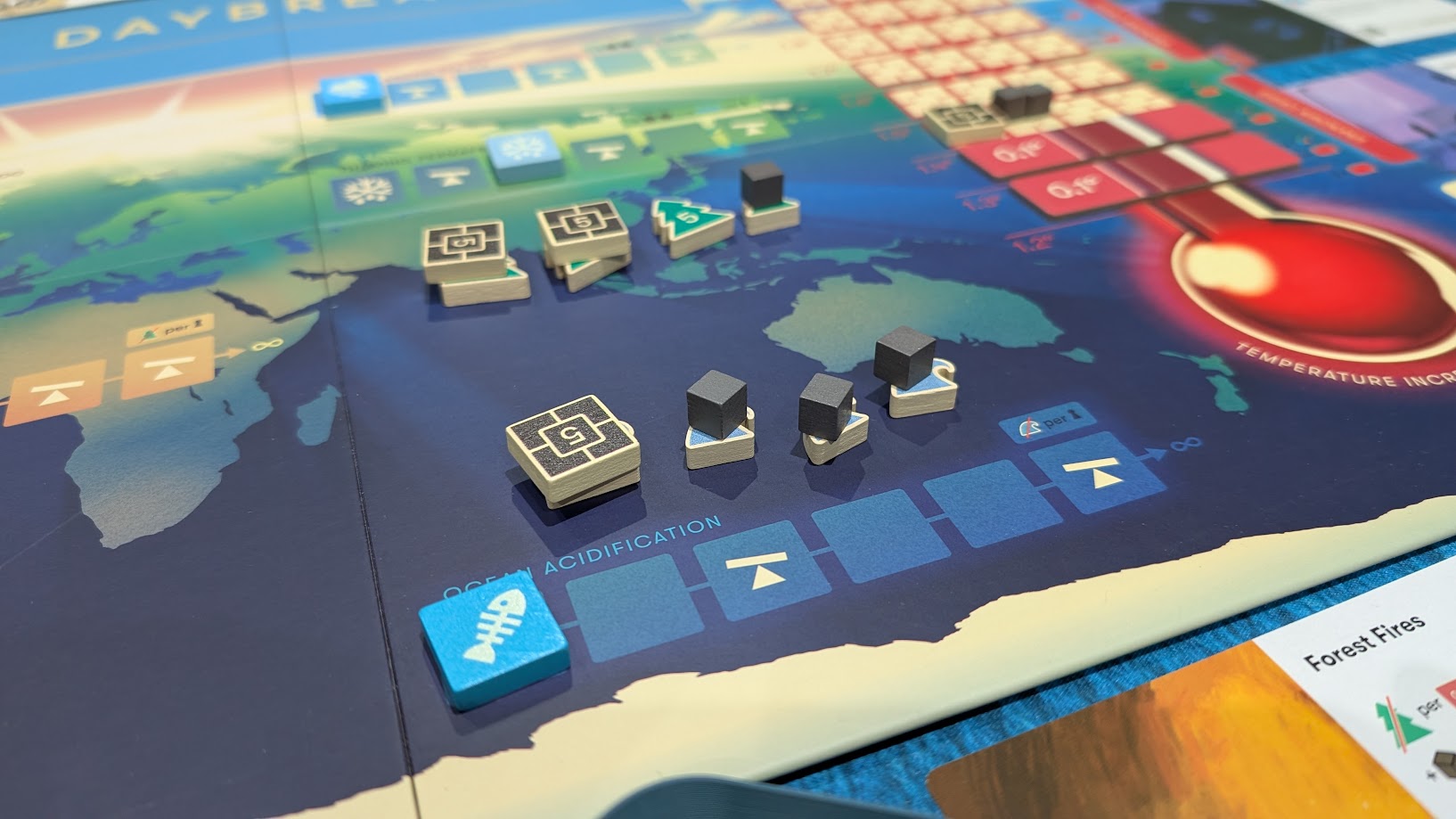
So, to begin the game, you have five actions available to you. Some might be one off per round, others are unlimited but require a cost each time. And they effect a lot of different parts of the game. Some will allow you to remove Emission tokens or Dirty Energy tokens from your board. You’ll want to do this as often as possible. Others let you build up Resilience tokens to help protect you and your co-op partners from the mean cards (more on that later). A few will let you build up tree and ocean tokens that gobble up (aka sequester) carbon cubes during a later phase which can really take the edge off the rising temperature mechanic.
But these five actions are somewhat weak and plain and wouldn’t get you far if that was all you had for the entire game. But that’s where the cool part of DAYBREAK comes in. Because the cards in your hand each round can effect your five actions in one of two ways.
The simple choice is to use the tags situated on the top right of each card. If you slip these behind certain Local Project cards they will beef up the strength of the action. For example, the Reforestation card lets you plant a tree if you have 2-4 Ecology symbols in that action space. But get a fifth one and now you can plant 2 trees per round. And there are plenty of other cards that grow with the increase in matching symbols supporting them.
Of course, you might have used a card to it’s full potential and not need it any more. Perhaps it was used to remove all of your Agriculture emissions and now you have none left. Well, that’s fine. Just take a Local Project card that is now more usful and currently in your hand and place it over the wasted one. Boom! New action. And the best part is that you can do this on the same turn. In theory, if you were to trigger all five actions, and then replace them with you new hand of cards, you could manage a ten turn round! Rare . . . but quite possible.
Oh, and the cards have a third use, but that related to something else in the game.
A lot gets mentioned about the games production and what it does to keep it’s own carbon footprint down (it would be pretty hipicritical to ignore the premise of the game by making it out of plastics). Upon opening the box, it’s very clear that a lot of thought has gone into component material and packaging. Obviously, decks of cards wrapped in paper isn’t new, but the biodegradable trays for the wooden componetns definitely is. Sure, the game could have included more smaller ones instead of four large ones (there are more than four types of components to divide up), but it’s definitely a step above the norm when even the games storage solution feeds off of the theme.
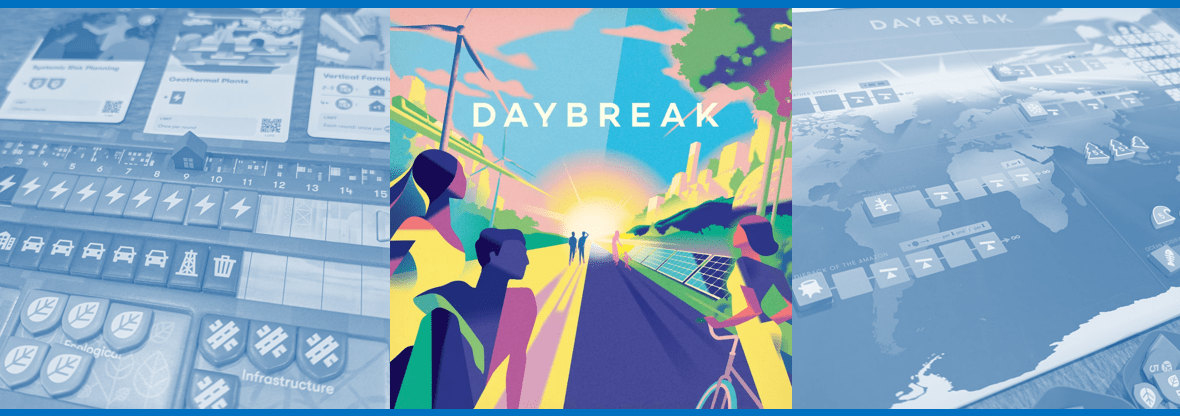
And then there is the art of the game. Everything has the vibe of modern looking posters taken from a climate change conferance. From the simple style of the world map on the main board to the individual Local Project cards, it all paints a view of positivy despite the bleak undertones of the game itself. It’s not a game about “we are doomed, doomed I tell you!”. It’s more about “hey, we’ve got this is we just work together.”
And work together you must. The game isn’t exactly turn based. The main action phase where players are triggering off their own action cards is simultaneous. This might cause you to put your head down and see how you can have the best round, but that’ll get you nowhere. Fast.
You see, a fair number of the Local Project cards can help other players. The game encourages you to work together by carefully planning your turns with each other and maximise everyones board state before the bad stuff comes. Going it alone will see no one win. I always think that’s really good for a co-op game, and DAYBREAK uses the cards in the players hand to negate quarterbacking. You have to all discuss what you’re able to do before formulating a plan as opposed to the entire board state being known by all.
But cool card mechanics and nice wooden components can only do so much. What if the game is just the same over and over again? Sure, the bad cards might come out in a different order or you’ll have different Local Project cards from a decent sized deck. But what mixes things up for those that play it a lot.
Well, for starters, the four factions all start differently. So much so that specific factions are suggested at certain player counts. But the game has a table in the back of the manual that says “hey, you want a harder game at 2-player? Try starting with China and Majority World. Good bloody luck.”
It also comes with a small deck of Challenge cards that mix up difficulty too. These are little rule changes that make things easier or more difficult, depending on how you’re finding the game. And what’s even better is that while some Challenge cards effect the entire group, others just effect a single player. Perfect for a veteran of the game teaching newbies.
Basically there are enough levers and switches to play with that will keep DAYBREAK interesting for a while.
ROOM FOR IMPROVEMENT
Despite my early enjoyment of DAYBREAK, and my fasination with the way players manipulate their Local project card area, a couple of things began to gripe for me, enough that I started to find my enjoyment lessoning. And, when I step back and look at what is causing this, it boils down to two things.
The first are those tags I mentioned. Now, their use in the game is brilliant. Sometimes it can be a tough choice between making a card one of your new main actions or using it’s tag instead because it causes another action card to cross a useful threashold.
The issue I began to spot is that, with 12 different tags on offer, luck of the draw can become a deciding factor in your changes of victory. I had a game recently where I needed two different tags to really beef up two different Local Action cards I had ready to go. But for two rounds, I drew a hand of useless (to me) tags. Not one. And we had a Project running that allowed an extra card draw, so that’s 12 useless cards. Did I feel like a handicap to the team? Heck yeah.
And on top of that, not all tags are created equal. On the back of the manual you’ll find a reference that includes the percentage of each tag. Want to do something cool that requires Wind power? Well good luck, as only 8% of the 158 cards host that symbol.
A thiner spread of tages would have helped this. For sure. Or more cards having multiple tags (to be fair, a decent number of cards do have more than one). But in a game that maxes out at 6 rounds, to have 1 (or in my case 2 which is a third of the game clock!) where you can’t do anything useful and are effectively treading water, doesn’t take much in predicting that you’ll lose the game (and yes, we lost that game).
But what irks me more than the tag issue, is those damn pesky Crisis cards.
I get that a co-op game needs a villain. In FORBIDDEN ISLAND it’s the Flood Cards. In PANDEMIC it’s the Epidemic cards. And in DAYBREAK it’s the Crisis cards.
Each one will have a negative effect. That’s fine. These can be negated most times, either by sliding Local Project cards under them (depending on tags) or by having enough resilience tokens to cover it. They are tough, but their meanness isn’t the issue I have.
To start the game you’ll place three Crisis cards along the right hand side of the board. One will be face up. That’s right, you have no idea what else will be coming at the end of the round. That first one is fine. Hopefully you have the option to protect yourself and others against it’s negative effect come rounds end. But those other two are a lucky dip.
As the temperture rises throughout the game, you’ll be required to have more Crisis cards waiting for you. And all the while, only the bottom one will be visible. The rest get flipped at the end of the round. Surprise. Oh, and you can’t react to it once it’s revealed. So saving cards is pointless even if you somehow have the correct symbol to be tucked by sheer fluke.
(I’m not even done and I can feel myself getting worked up, lol).
Because there are still more issues here. Some Crisis cards can effectively be removed once a criteria is met. Place two cards with Regulation tags under it and it’s covered for the rest of the game. Discard. But other Crisis cards can’t be gotten rid of. They can be defended against, sure. But that defense will most likely have to be improved as it’s punishment feeds off of the temperature track. And it will never go away.
“That Crisis card is out there! It can’t be bargained with. It can’t be reasoned with. It doesn’t feel pity, or remorse, or fear. And it absolutely will not stop… ever, until you are dead!” – Kyle Reese
Okay, that’s a little dramatic. But by round four, when you’ve gone through 12 Crisis cards, and 7 of them are still sat there laughing at you, it can be a little much. Worse still is the lack of variety in them. Once game I played saw three Crisis cards with pretty much the same effect, the same punishment, and were all revealed during the first two rounds of the game. My teammate suffered greatly from these punishments, and we didn’t come close to making it past round four.
Okay. Rant over. It seems like the Crisis cards from DAYBREAK might be a trigger for me a little. But I’m wound up by it more because I really enjoy the other aspects of the game. It’s a version of PANDEMIC that I prefer theme wise, and the way the Local Project cards are utilsied fasinates me. So my annoyance with the Crisis cards comes from dissapointment; this game could be great, not just good.
When things don’t overwhelm the players too much, and when luck isn’t sat at the steering wheel, I can really enjoy the game. But, after setting things up and getting ready to save the world, I really hate knowing from the start of round two that nothing but a loss is on the horizon.
EXTRA CONTENT?
There are currently no expansions for DAYBREAK.
FOR 2-PLAYERS?
It feels most challenging at 2-player. Less card actions available to effect the board state. Less players to choose from for taking hits off the Crisis cards. While the higher player counts produce more carbon between them, the thermometer track scales with player count, so it doesn’t feel you get swamped more in carbon just because you double the player count.
| – – CONCLUSION – – DAYBREAK has a number of things that I really enjoy. The way the Local Project cards are used is really interesting, forcing you to choose tags over actions, and planning it all out to be most effective as a group. However, the luck of the draw can really affect the outcome, and sometimes you can be drowning in Crisis card effects from the beginning of the second round. It looks beautiful, it brings some great mechanics to the table, but it doesn’t quite stick the landing. |

Review #0225
[ Review copy supplied by VS Distribution, obtained through Mason Williams PR – however, thoughts and views are my own ]
 Always Play Blue