| PLAYERS | TIME | DESIGNER | ARTIST | PUBLISHER |
|---|---|---|---|---|
| 2-4 | 60-120 mins | Cole Wehrle | Kyle Ferrin | Leder Games |

METHOD
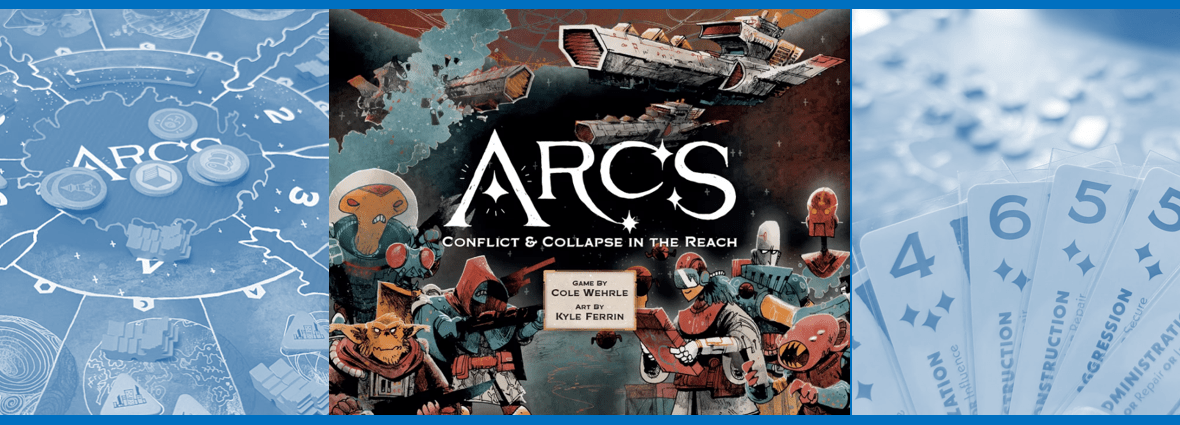
ARCS is a space game. It’s pretty obvious with the planet littered space board and wooden spaceships. But it most definitely sits apart from what you might picture first when someone asked you to name a space themed board game. It’s not your typical epic big box like TWILIGHT IMPERIUM or ECLIPSE, but that is the group it would sit among.
Players represent the leaders and officials of different factions, all trying to survive as part of a failing Empire, all trying to somehow vie for control and come out on top.
But how do you go about that? Sure, you can go in all guns blazing and aim for nothing but a dice roll enfused battle game from start to finish. Maybe you want to avoid shooty shooty tactics and instead use you cunning to gather a plethora of Guild cards that can help you out in imaginitive ways. Or you could hoard resourses or ancient relics.
It’s all available to you, in a way. If the cards allow it. Because unlike most games of this ilk that let you choose turn after turn from a long list of available actions, this one uses a trick-taking mechanic to control what players can do.
POINTS OF INTEREST
This is one polarising game. When ARCS landed, the review scene exploded with two types of thoughts; “ARCS is the best game ever!!!” or “this game is a hot mess”.
A lot of this comes from the trick-taking mechanic that is used to control your actions each turn, as well as who will have the initiative. And I can see this as being an issue for some. But I also feel that it might be preconceptions to this method of action selection that has players already opposed to it before a ship has even left space dock.
ARCS isn’t a trickitaking game. A player shouldn’t look at their hand of cards at the start of a round and become deflated if all their numbers are low, or gain extra confidence if their numbers are all high. The first thing that is important are the suits themselves. These will dictate where you’re best to focus you plans for the round.
More over, there is always a way around things. Maybe you wanted to do something else, but now the lead player has picked a specific action you weren’t needing. Perhaps you can use it now, get rid of a lower card of the same suit, bide your time. Or, if you want to stick to your plan, instead you can pivot, laying a card face down and carrying on as you inteaded, only a little weaker . In doing this pivot action, you could even get rid of a card of a different suit than the one you wanted to use, saving that stronger card for later in the round. And if you’re after that initiative but don’t have cards high enough to take it, the game gives you an option to deal with that too. It mighty not look ideal, but if going first is important, then sacrifices need to be made.
Something else that I really like about the cards you use for actions is that they are multi use, in a number of ways. While a card named Aggression might sound like it’s only good for combat, it comes with two other actions; move and secure. These are equally useful. Move ships around to secure planets or block routes. Secure those Guild cards you’ve been placing Agents on. These are two great actions that don’t require you to fire a single shot.

But what of combat? With all these ships zipping around all the systems of the map board, tensions are going to rise and people are going to use Aggression for how God intended.
Well, ARCS has a nice way of doing things with a fast paced combat that allows the games general pace to remain constant. It’s devoid of brain melting math. Players aren’t pulling out a million cards that affect the outcome in implausible ways. And it doesn’t go on for round after round after round.
The attacker waltzes up, delcares their intentions, selects dice based on the number of ships they’ve brought to the fight, and then have at it. One roll, one result. Damge done. Simple.
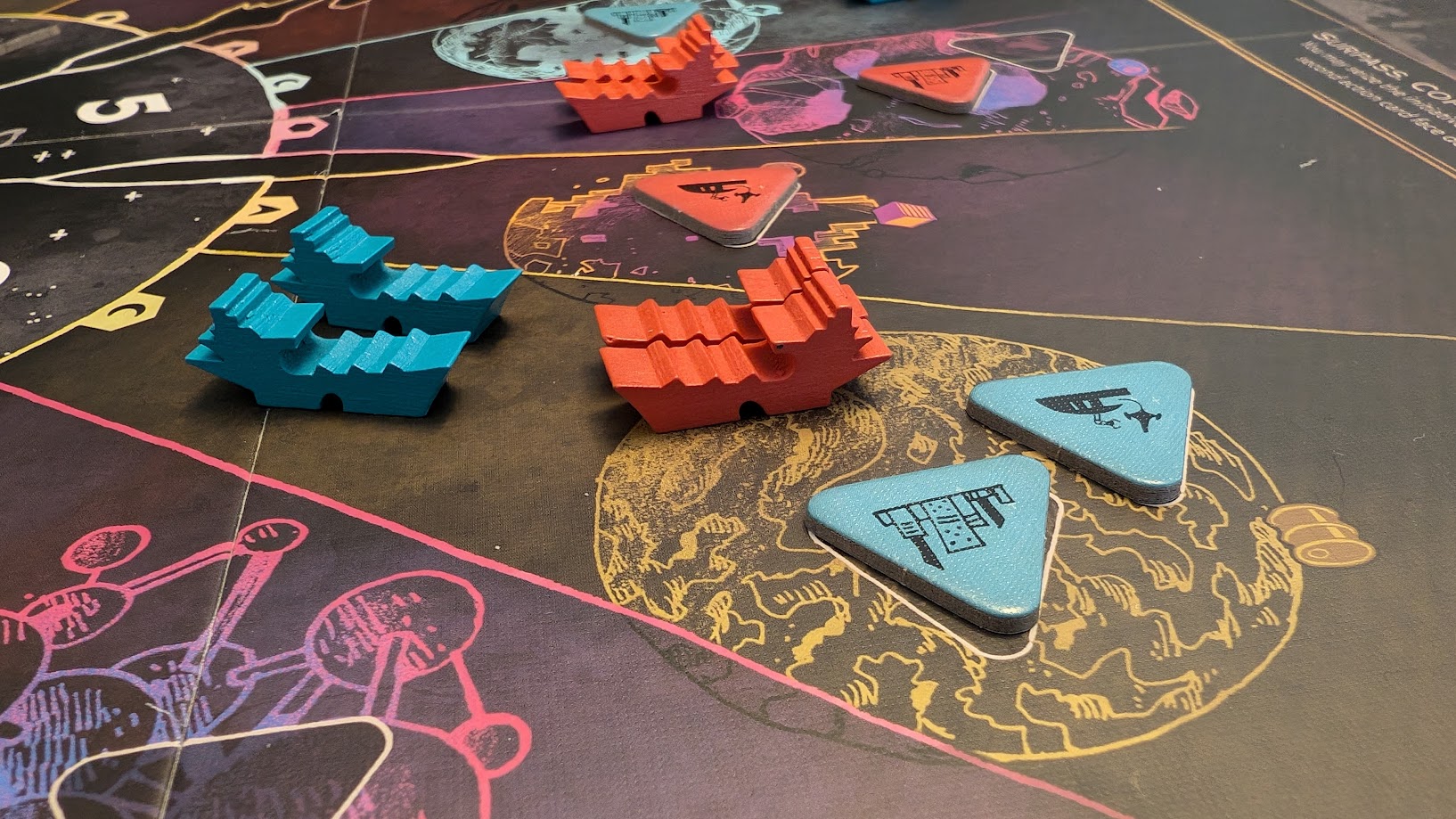
Okay, there are nuances to it. There are three dice to select from, each with pros and cons. The blue dice (Skirmish) only have a fiew hits on them. These are prone to miss often. But they’re are also the safest. In contrast, the red dice (Assault) hit harder and more frequent, but you’ll be taking damage back too. And then the Orange dice (Raid) are great for stealing stuff from the defender, though they can cause you to get blacklisted by guilds. It’s worth noting here that your opponent doesn’t roll defense, or their even own attack dice in retaliation. The attacker controls everything. They pick the dice and they allocate the damage. It sounds ruthless, but it’s what helps keep the battle mechanics lean, preventing the game from getting bogged down.
Something extra that I love about the game are the Leaders and Lore cards. These give an asymetrical slant to the game. Players choose from a selection of ‘characters’ and this will define where you set up, your starting resources, and also give you a nice little ability or two that others don’t have. What makes it interesting is that these cards also give you a weakness too. It all adds magnificently to the flavour of the game and can aid in shaping a players strategy. Bring in the LEADERS & LORE expansion, which just adds more of these cards, and the combinations are huge. Using these cards gives an extra layer of layer to the game and I would probably only play without them now if it was a whole table of new players.
Finally, let’s talk art. Kyle Ferrin has a very distinct style. His beautifully cartoony work clings to a lot of Leder Games products and here it’s in full force once again. It’s another aspect of the game that can be polarising for gamers, and it’s another factor of ARCS that I really enjoy. It’s a side step to the genre, keeping the black starkness of deep space and laying across it the standout neon and funky characters. Seeing the iterations of the board through the design of the game, it’s definitely ended up in the best place. The circular nature to the layout and the colour coded planets give a different vibe to giant hexes with star field backgrounds. It’s unique in all the right ways.
ROOM FOR IMPROVEMENT
Now I’m not saying ARCS is a perfect game. It has issues, or if I’m being more accurate, it has things that even I find troublesome.
For starters, the way the game scores can sometimes make or break a playthrough for me. While I champion the action selection mechanic that Cole Wehrle chose for how it directs players and makes you seek out the efficiency in you hand, using that same mechanic to control the game’s scoring was a harder pill to swallow.
On a turn, the lead player can choose to make their card a zero value, effectively giving up initiative for the next round. But, in doing so, they get to dictate scoring for the end of the round. As the game has five ambitions of score, and only three scoring tokens each round. So chosing which of the five scoring goals are selected each round is key. Moreover, the scoring tokens are different values, so not only do you want to chose what scores, you’ll want to get the most points for it if you aim to win that goal.
But now that you’ve delcared your ambition, everyone knows it. This will make it harder to obtain if the other players work to hinder you. And they most likely will.
At first I found this interesting, and my early games were 2-player, so I didn’t sturgle with it too much. But in 4-player games, if you don’t get a chance to pick an ambition you’re already doing well at, it’s hard to fight three other players, some who most likley have a head start by the time the ambition is selected.
Yet it’s not the ‘I’m not doing good‘ that irks me. It’s back to how the cards select the ambition. You see, a few things need to be lined up for you to select an ambition. You’ll need to be lead player, so you’ve got to earn that first. Then you need a card that matchs an ambition you’re after. Because each number in a suit also relates to an ambition.
So, while you might have a bunch of enemy ships on your player board, and you might be first player this round, you can eye up the Warlord ambition all day long if you don’t have a number 4 card of any suit in your hand. You’ll be unable to declare it.
And it’s this I found frustrating. Bending a ‘bad‘ hand to function well is a nice challege. Being locked out of even trying to score points is frustrating. Because it’s harder to pivot a strategy mid round, especially when the resource tokens are so limited (there are only five of each in game). If you’re sitting pretty for Warlord, and a player selects Tycoon, and all five tokens are already in players possession, you’ll need to use your actions to try and grab those tokens yourself. It’ll be an uphill struggle.
I’m also not keen on the tokens used to block the gateway locations and planets in lower player counts. While the distinct artwork of the baord is beautifukl, it also makes things look busy, especially adding in all the player cities and ships too. The tokens are a small as they can be to block the space not in use. So for a planet, it’s a small cardboard circle.
It sounds nitpicky, but I would have preferred a cardbaord panel in the shape of the zone being ignored to place over it, perhaps without anything other than plain black on it so that it was clearer to see. It sounds silly, but the board can get messy at times, and this small thing makes it more challenging to decipher.
EXTRA CONTENT?
The game comes with two expansions so far. The LEADERS & LORE pack is absolutely worth adding to the base game, just because it doubles you sets of Leaders and Lore cards. I kind of feel like it should be included in the base game already instead of being a purchasable extra.
The other avaialble expansion is much more bang for your buck. THE BLIGHTED REACH brings a replayable, three stage campaign to the game. It appears to be something great for that group that plays ARCS a lot and wants more out of it. I think that if you gets ARCS to the table on occasion, or if it’s always different people, it might be hard to step up into the extra complexity it brings.
To note, while I have LEADERS & LORE, I’ve not purchase or played THE BLIGHTED REACH at the time of this review.
FOR 2-PLAYERS?
ARCS at 2-player is interesting. First off, a bunch of changes are made to the game, with action cards being removed as well as certain areas of the game being made off limits (this part is true of 3-player too). There’s no dummy player or extra admin, which is nice. The game is just constricted a little.
But how does it play? Well, it has pros and cons. You’re able to to plan better and accomplish more at 2-player. You could sit on opposite sides of the galaxy and not fight once, working hard to race towards the ambitions. And while it makes the open space setting feel themeatically vast and stark, it can fall into a bit of an eventless game.
While 4-player can be more challenging and ever changing, the amount going on and the chaos that it all brings can make for an exciting game, something missing at just 2.
That said, I like the game enough that I enjoy it at all counts.
| – – CONCLUSION – – ARCS takes a genre and presents a different view of it. It shrinks down almost every aspect of it’s bigger 4x brothers and makes it an equally heavy game that fits into a smaller time span. While the trick-taking method of action selection might not be for everyone, there is a fantastic game to discover beneath it, one that is more about the journey than the destination and rewards repeated plays. |

Review #0205
 Always Play Blue