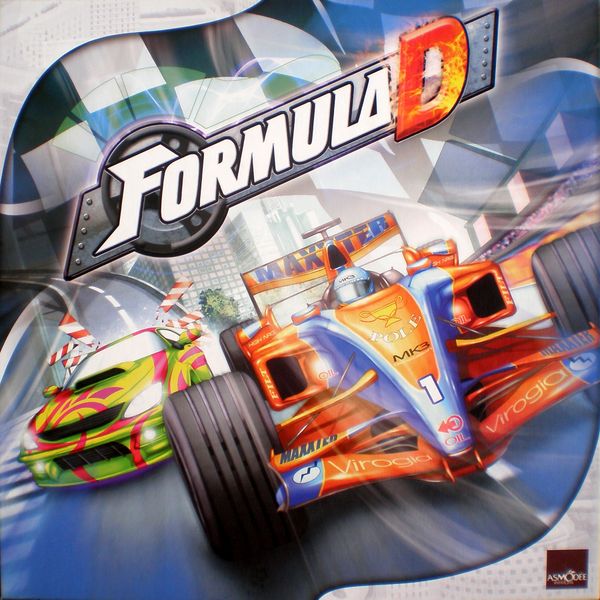
In FORMULA D, players control one or two racing cars and speed their way around iconic (and non-iconic) circuits.
And while the ‘roll and move’ mechanic skeleton of this game may seem a little out dated, the extras that surround it take it up another level.
So it’s the roll of a dice that determines how far cars move on a turn, but players use a little control panel in front of them to simulate what gear they’re in.
Seriously, you have a little plastic gear stick, and selecting a gear to be in not only decides which dice you roll (first gear is a D4 showing 1-4, while sixth gear is a D30 showing 20-30), it can also cause damage if you in the wrong gear at the wrong moment.
My friends and I have followed Formula 1 for many years, and I love the little simulation add-ons like car damage, and corners controlling your speed (corners have a minimum stop requirement).
It may not look it, but there is a nice little tactical element in there, as you decide when to push too hard, and when to drive with a little finese.
The race cars are tiny, and the track boards are massive (double boards!). A lot of the additional track boards you can buy are based on real world circuits, so if you are a fan with like minded friends, you could easily put together a little mini championship.
Some may not like the roll and move mechanic, despite all the bells and whistles around it. I can understand the frustration of losing a race because you rolled lower heading to the finish line.
And the game can be long if you play proper rules of two laps, pitstops, and accurate damage. Heck, there’s even rules for a Quali lap first if you want to make a day of it!

Despite its old school dice moving mechanic, FORMULA D is still one of the best racing board games out there. It dominates the table, and is a lot of fun for a group of racing enthusiasts.
 Always Play Blue