| PLAYERS | TIME | DESIGNER | ARTIST | PUBLISHER |
|---|---|---|---|---|
| 1-4 | 30-60 mins | Martin Wallace | Cari Cyril Nouvel Emile Denis J B Casasola Miguel Coimbra Olly Pascal Quidault | Space Cowboys |

METHOD
Compared to Martin Wallace’s most famous game, this one is a contrasting box of absolute simplicity in it’s mechanisms and strategy.
Each player represents a group of survivors. The aim is to travel across America, heading from Chicago, following the famous Route 66, and ending in LA.
Oh, and this is all happening during a zombie apocolypse.
The game utilises a little bidding, a touch of push-your-luck, and a fist full of dice chucking combat to raise the tension as you all make your seperate ways across country with the goal to make it to the sunny West coast with the most survivors.
Though sometimes, just having one left might be enough.
POINTS OF INTEREST
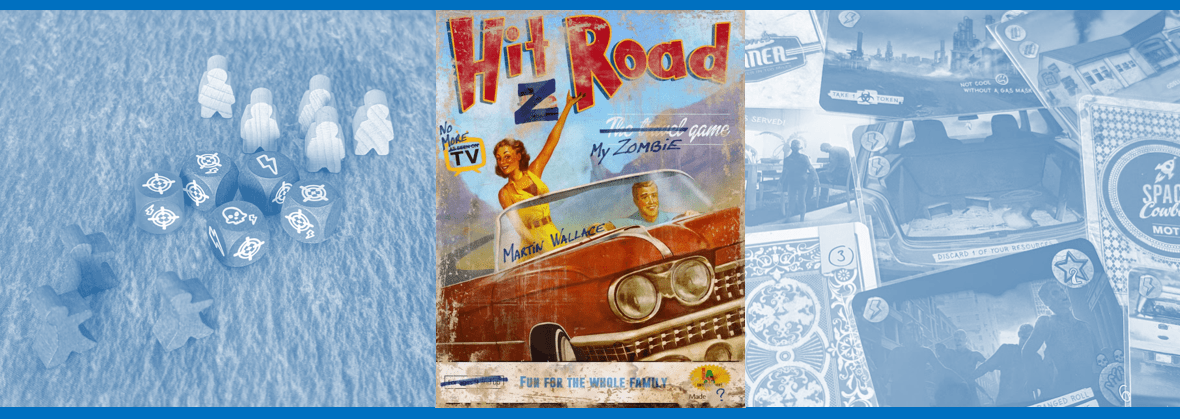
The first thing that stands out with HIT Z ROAD is how much the theme and the backstory of the game are baked into the components. I’ve seen games try this before with light sprinklings of story and character dotted on cards and the rulebook (THAT TIME YOU KILLED ME is a good example of a character writing the rulebook). But here it’s dialed up to 11.
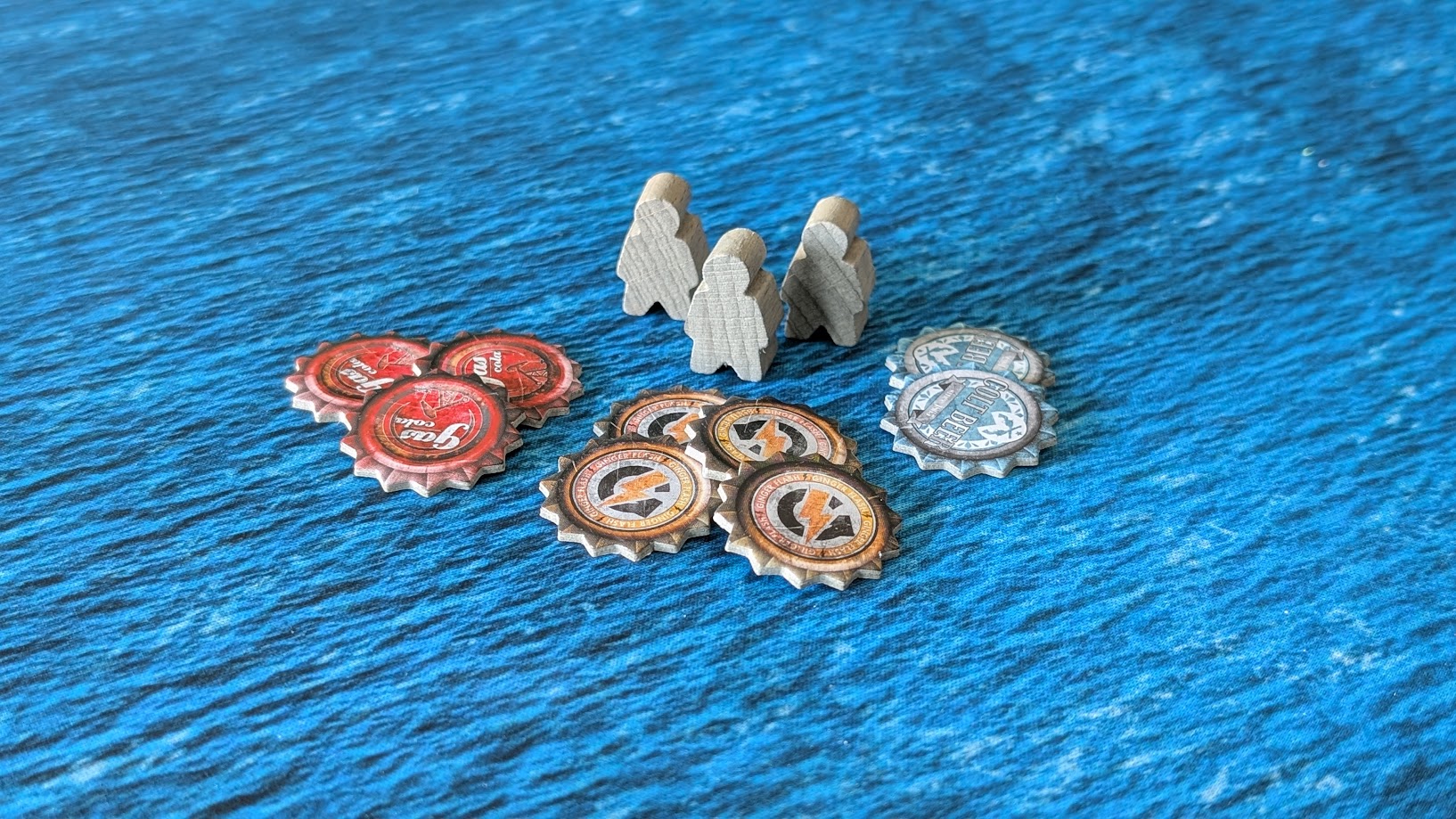
The story behind the game is that a kid (named Martin) is travelling through Zombie infested America with his family. To stave off boredom, little Martin has been gathering things from the remains of the world, things that he’s modified so as to make his own boardgame. The box art, the cards, the tokens; everything was something else once. The tokens are different bottle caps. The location cards are just three decks of playing cards with ‘photos’ stuck over them. Every componet has Martin’s marker pen scribblings on them to alter their purpose for his final product. The game is full of little easter eggs and in jokes and it completely elevates the game, making it fun to bring to the table before you even start explaining the rules.
Something that makes the teach easy, especially for newer gamers, is the ease of combat. At first it appears daunting with the amount of symbols dished out across the black and red dice. But it’s far from difficult to decipher.
A single dice represents one of your survivors. The more people you keep along the way, the more dice you’ll roll. You choose to spend blue bullet tokens to take a range shot first, something that offers a little protection for your little woodens guys. After that, the brain chompers have closed in and it’s melee for the main course.
What’s interesting is that the basic black dice have no insta-fail option. Most of the faces either miss, hit, or require you to spend adreneline tokens to avoid death or improve hits. So, while a single dice face has that daunting skull icon on it, careful management of resourses can prevent loses. Of course careful management of resources is sometimes easier said than done. This is the end of the world, after all and resources aren’t just lying around.
Each round of the game sees rows of cards laid out, and these are the routes available for this stage. These location cards reveal a mix of obstacles, punishments, and rewards. The randomness from the card draw each time will mean that some routes are obviously more inticing than others. Players will spot resources as rewards and be desperate to claim them, but is the route to those specific rewards safe from danger? Does the risk to claim cost too much, even if you succeed? Is it really worth it?
Of course you’re choice of route will most likely be reduced. This is where the bidding mechanic comes in as you give up resources at the start of each round to clamber for first choice. It can be expensive to remain ‘safe’ for the whole game, and bullying for first place too often will leave you vunerable in future rounds.
Tough choices lay ahead.
ROOM FOR IMPROVEMENT
My biggest issue with the game is just how tough it can be. Not that difficult games are bad. Instead, it’s more that the game appears super light and basic, hiding it’s dissappointment and unfareness deep beneath the surface. While turns are simple and flow really nicely, the game is harsh. This of course comes down to a couple of things.
The dice are the main culprit. Luck can smash your game to smitherines from the get go. Lose a few survivors and you lose dice, which in turn makes you less effective next time round. And avoiding Zombies ins’t really a choice, especially in the later game.
Difficulty is also increased over the course of the game as the cards ‘level up’. There are three sets of cards in the game, and the closer you get to LA the more danger is revealed from them. The level three cards can be brutal, more so if both your cards that round have high numbered Hordes.
You see, Hordes replace a number of combat dice. These extra spicy red dice have a extra spicy skull face on them and this time it is instant death. Just when you’re at your most vunerable, the Zombies get meaner.
Again, difficulty in a game is no bad thing. It’s more that in some games, the jouney has been so grueling, that no one has made it to the end. This can be quite defalting. To have played a competative game for almost an hour with no winner might irk some.
And even if someone does make it all the way, this game still has the dreaded ‘player ellimination’ which can put a dampner on any players evening if they go out early and end up just sit there.
EXTRA CONTENT?
Nothing available.
FOR 2-PLAYERS?
The game works pretty well at 2-player. The game length comes down (I’d say that overall it’s about 15mins per player from experience). The game has a few changes made to set up like specific marked cards being removed, and having an extra cost on the third row of the location cards. It also makes things a little easier as the bidding phase won’t stretch out meaning you’re likely to have more bullets, adreneline, and gas as you go further in.
| – – CONCLUSION – – HIT Z ROAD is a fun little gem of a game. The mix of simple gameplay while slowly discovering the game behind the game are great for keeping players engaged and not waiting around. Once bidding is over, turns are short and sharp. Sure, it can be tougher than presents itself, but however the journeys turn out, you’re all in it together. |

Review #0201
 Always Play Blue