| PLAYERS | TIME | DESIGNER | PUBLISHER |
|---|---|---|---|
| 2 | 20 mins | Trevor Benjamin Brett J. Gilbert | Lookout Games |
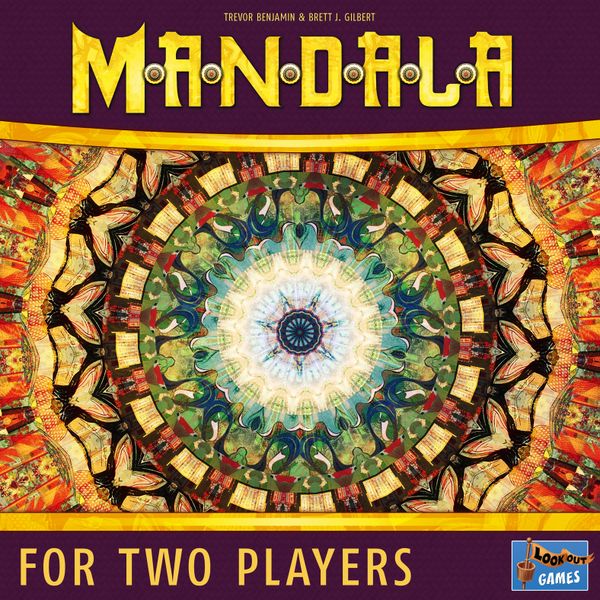
Players will be playing cards to one of two Mandalas which each consist of one shared Mountain and two opposing Fields.
Now it’s not as simple as looking at your cards and picking what to play. ‘What’ you place isn’t even half the decision.
While your first choice is “what colour card(s) do I play?”, there are two Mandalas running at the same time, and each has two locations.
So it’s not only what, but where.
And with each of the six colours only allowed to exist in one of the three locations within a Mandala, it’s the placement of the sixth colour that triggers a scoring phase.
So it’s not only what or where, but when.
The game looks simple. Just placing cards on a beautifully designed mat.
But inside a players head they are deciding which Mandala to make process on, whether to add another card to the Mountain to give it more scoring potential, or add it to their field to gain control of the mountain when it triggers, or to place that final colour because it benefits them at that precise moment.
It’s a lot to think about and that’s what makes it such a good 1v1 game.
From such basic components (a single play mat and a stack of cards) there are a lot of plates to spin each and every turn.
And then the scoring mechanism means that, as the game goes on, you’re after specific colours because they score higher the further up your River they’re placed.
It’s not perfect. The luck of the draw can sometimes see you struggling to get anywhere on either Mandala.
And it can be annoying when your opponent finishes a Mandala early, or suddenly places a big hand in their Field and you lose control of it and the cards you were after.

Overall, MANDALA is a great 2-player only game. It’s very thinky, has simple rules surrounded by plenty of depth, and plays in about 20 minutes.
 Always Play Blue