| PLAYERS | TIME | DESIGNER | ARTIST | PUBLISHER |
|---|---|---|---|---|
| 2-4 | 45 mins | Reiner Knizia | Anna Przybylska Kate Redesiuk | Mighty Boards |

METHOD
You play as clan leaders who are competing to restore the land in a future where calamities have left the world a bit of a mess.
The game is a simple tile laying game. Each turn you’ll place a tile that represents your clans contribution to the project and score it immediately, unless it’s a building tile that requires certain areas to be completed.
But there’s more. Some spaces let you build castles based on surrounding area majority. Other spaces let you draw an objective card to potentially gain end of game points.
After each player places their final tile, the game ends.
POINTS OF INTEREST
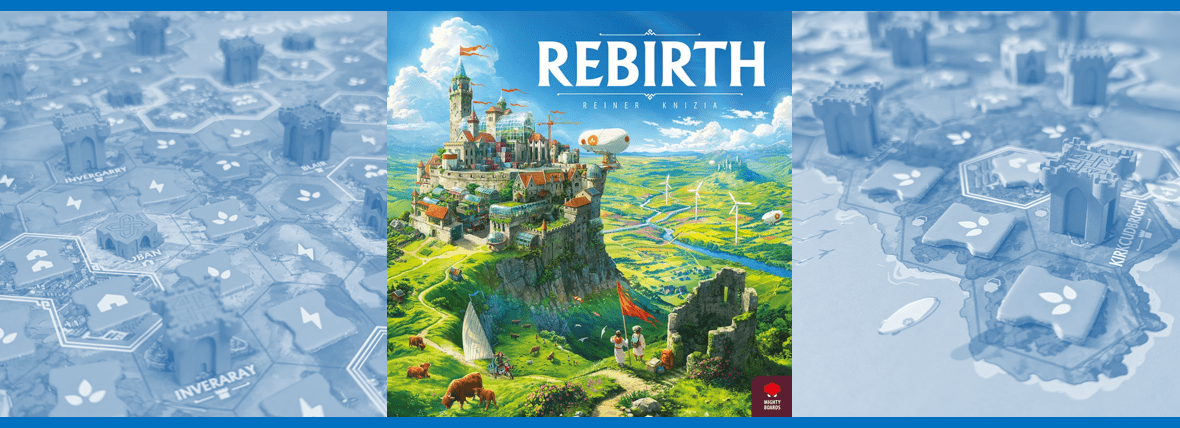
I’ll start by saying that REBIRTH is not the sort of game I assumed it was upon first seeing it set up at a games meet. The map board, the castles pieces, and the hex spaces all screamed some sort of war game. It sounds silly now that I’ve played the game, but that’s how I percieved it. I even assumed it was historical, being that the two maps are Scotland and Ireland. My brain just linked all this together and formed the image of a game that is not what REBIRTH ends up being.
It’s actually a relaxing and very simple tile laying game. Sure, there is an area control aspect when it comes to claiming castles and completing objective cards, but those tiles you place, they don’t move. Once a tile is commited to a hex space, that is it’s home for the rest of the game.
It’s the game’s simplicity that truely makes it shine. The large board and it’s detailed artwork can make players feel like they are sitting down for an epic strategy game, but each turn sees you just placing a single tile. More fasinating is that you’re not chosing from a selection of tiles as you would be in games like CALICO.

All of your avaialble tiles are face down at the start, and there they remain. Once your turn ends, you chose another random tile from in front of you and that’s it. Maybe it’s not what you really wanted in that moment, so you’re just going to have to role with it. The only decision space in the game comes from where you are going to place that single tile to maximize its effect.
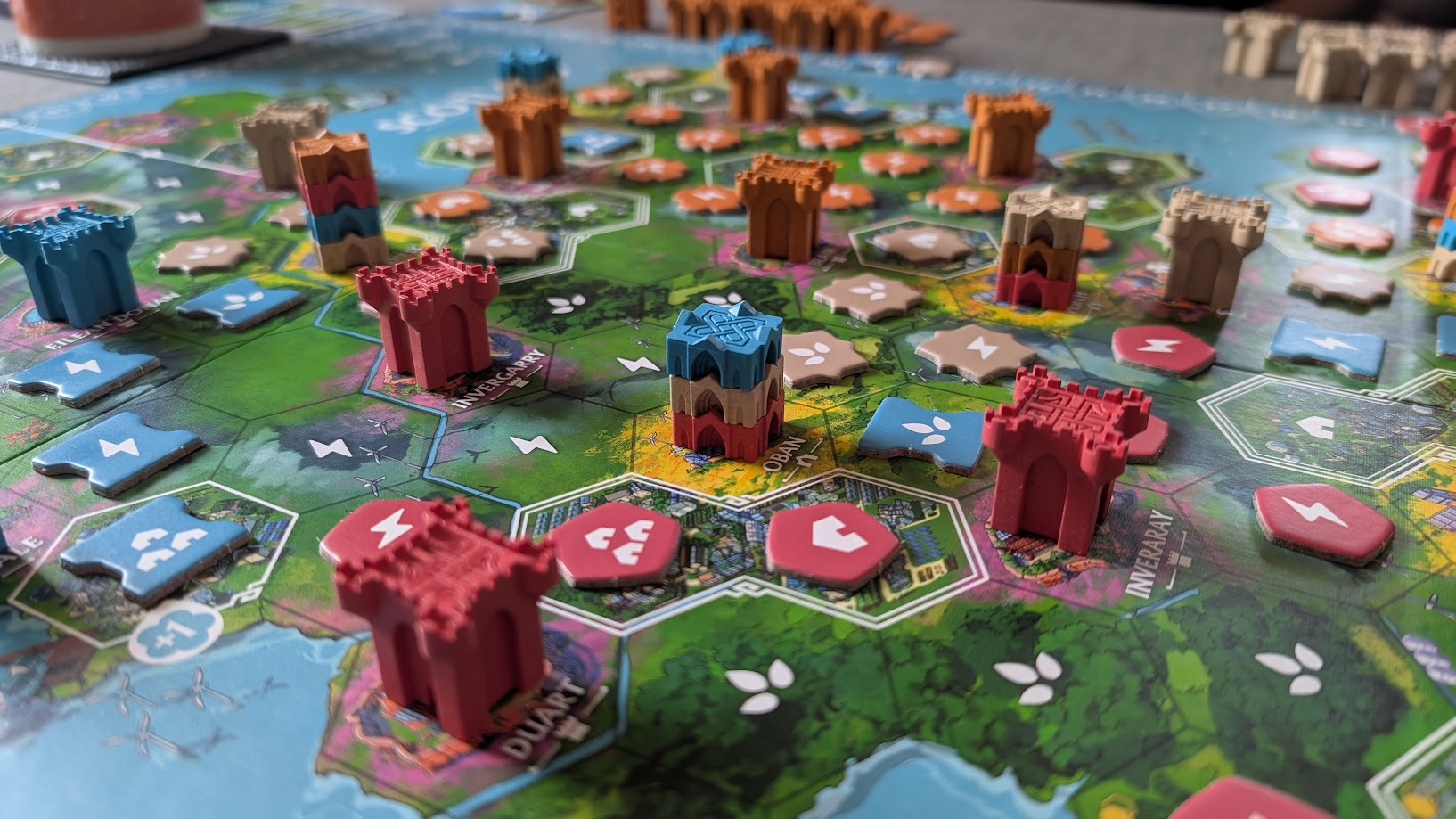
The basic tiles are food and energy. These are worth a mere 1pt on their own, but they score bigger when placed next to your matching tiles from previous turns. So add an energy tile adjacent to three others already grouped together and it scores 4pts instead.
This is where the mild stratery starts to creep in to REBIRTH. Because you can just keep adding to a clump of your energy or food tiles to score bigger and bigger each round, but you could also block and interupt another player doing the same, cutting them off from running away around the score track.
There are also a few more factors to consider with each single placement. Place next to a castle spot and you put down a wooden castle in your colour. This is the only way to place a castle, but having it on the board doesn’t make it secure. Castles are targets for conquering, and this is as simple as having more of your colour tiles surrounding said castle.
Catherdrals are good too. As soon as one of your tiles sits next to it, you draw an objective card. This is yours and only yours, and it can be usful to give yourself direction with the need to place tiles a certain way or in specific locations. Great to get early.
As well as the basic tiles, you also get settlement tiles that are placed on specific locations and have their own area majority that only score when the marked town spaces are full. There are a range of these spaces dotted around the board between 1-4 hexes ins size. Of course it’s not easy to score big here. It not only requires you to have a settlement tile in hand ready to strike, but they come in 1-3 size too, with the higher numbers being necessary to claim the big points.
And that’s just the Scotland map. On the reverse of the board is Ireland. It doesn’t just bring a new board layout, but it also changes a few of the mechanics. This time there are public objectives that give more points to the first player to score them. It’s great to have these ready to go from the start as it gives more control to the spaces players will be fighting over.
There are also Tower spaces that each have a unique ability to use when you place next to it for the first time. These are great because you know the ability up front and it lets you take that information into you plan for that turn. Some are just extra points, while others let you take an extra turn.
Ireland is easily my favourite of the two maps, and I would probably only play Scotland now if it was a teaching game, or if I wanted a change of pace for a play or two. I really like having the broad range of objectives to fight over. Scotland is great, but you get the personal objectives in drips and drabs unless you just place your first few tiles around the cathedrals early on. I’ve had games where I’ve drawn a card in the second half of the game to find that I cannot complete it anymore.
The game is super simple to teach with an extremely low rules over head. And having just one tile in your hand per turn means that AP isn’t common. Because you pick this up at the end of your turn, it gives you time to evaluate it’s placement which really speeds things along.
ROOM FOR IMPROVEMENT
Despite the beautufil artwork on the board and the fun, bright colours of the components, there is a small issue when it comes to the player tokens. The quality of the tokens isn’t the best, and across the different copies of the game I’ve played so far, I’ve spotted some degredation to the backs and the edges that could make certain tiles easily identifiable, giving you a definite advantage.
Of course this could be resolved, though at cost to the games owner. Some folks have already produced some nice 3D printed versions of the tokens which will last much, much longer with sustained play. Coin capsules might also work as a solution. This is a lot of people do with the ARKHAM HORROR LCG Chaos bag tokens or QUACK’S ingrediant tokens.
You could combine either of these options with a bag for each player to draw tokens from too (something I believe was included in the Kickstarter). It would save having all your tokens on the table for the whole game. And who doesn’t love rooting inside a bag to pull tokens? Seriously.
EXTRA CONTENT?
The game was only released last year, and as of the time of this review, there are no expansions available.
FOR 2-PLAYERS?
The game works pretty well at 2-player, though keeping players in check can be more difficult. You are the only person to block your opponent if they are starting to score a big food or energy area, and this will use up your turn. At 3 and 4, this task gets shared out a little more.
I find the Ireland map works better at 2-player as well because it’s an immediate race from the start as you both work towards the public objectives.
| – – CONCLUSION – – A game that is a lot simpler to teach and play than it might first appear. The lack of tile choice each turn works in the games favour giving it a nice flow and reducing all that unnecessary thinking. The theme and future setting might slip past most players, but that doesn’t prevent the design and artwork looking absolutely gorgeous. |

Review #0203
 Always Play Blue