| PLAYERS | TIME | DESIGNER | ARTIST | PUBLISHER |
|---|---|---|---|---|
| 1-4 | 80-160 mins | Alexander Pfister | Klemens Franz | dlp Games |

METHOD
You play a group of pioneers, leaving civilisation behind and heading to the titular Boonlake to start your own community. You’ll explore hexes, build houses and villages, and raise cattle, all while travelling around the rivers that act as the games timer of sorts.
POINTS OF INTEREST
Something about this game constantly called to me over the years. Every time it popped up on someones feed, I’d take an interest in it, but never make the purchase.
But it was bound to happen eventually. We’re big fans of GREAT WESTERN TRAIL, and this one is from the same designer with some similarities. Surely it was a no brainer.

First, lets talk action selection here. The game uses a board with each of the seven actions placed upon it. When a player takes an action, they lift the cardboard token, place it at the bottom of the selection board, carry out the actions, move their boat along the river (more on that later), and then push all the action tiles up.
The main purpose of this is two fold. First, it stops actions being repeated over and over by all the players. You can play recently used actions, but the soon you take one, the more it may cost you. In some cases, this cost is actual points. It also controls the pace you move down the river itself. Each action is next to a boat movement amount, with the higher up the action selection board you choose from letting you move further. So taking the actions that have been on the action board the longest means moving further.
It sounds weird, and is extremly tough to explain in writing. But it’s a clever mechanic that, once you click with it, ends up dictating your progress through the came and your strategy from turn to turn.
Players spend a lot of the game with a hand of cards that will constantly be used and freshed. Six of the seven action tiles allow you to play a card, either for cash, or for a benifit. Cash is usually just two coin and done. The card benifits though, are the real bread and butter of the game and come in three flavours.
- Instant bonuses will usuall let you do something useful there and then. Upgrade a house for cheap. Move your marker down one of the tracks (here they are actually tracks for mine carts!). Gain a vase. It’s all pretty simple.
- Ongoing bonues usually give you some kind of discount when carrying out an action or an extra cash bonus when you’d receive coin for something.
- End of game scoring cards do exactly what you’d expect. They set you up to score some juicy extra points come the end of the game, and can sometimes be the difference between winning ands losing.
They cards are great, and very effective once you learn them, and get used to not getting attached. The cards all have cost. Money is often involved, but so are resourses. This’ll lead to you having cards you want to play but can’t afford to in the moment, and it’s usually benificial to use that card later for income instead of spending the game ‘saving’ up to get it played many turns later. Besides, there is not only a decent amount of variety in the many cards you’ll see, but there are duplicates and other cards that are very similar.
Speaking of resources, things are done a little differenly in BOONLAKE. You don’t have piles of resource cubes scattered around your table, shuffling back and forth between your player board and those handy 3D printed component trays.
Here, you have canoes.
Okay, so they are boats. But they look like canoes. Each player has slots on their board that represent the four resources of the game; Wood, Loam, Stone, and Iron. Over the course of the game you’ll gain tokens that give you a permant +1 or +2 of each resource, but to start you just have two boats. You can move them at any time up the river to count as one of the resource it sits below.
When you play a card, you just have to make sure you have a temorary or permant resource of the type the card requires. It’s a really unique way of utilising resources in a gain, and again, it’s a little puzzle that you need to click with to get the most out of it. Planning on where your first +1 resource token goes will depend heavily on your starting hand of cards.
And this is all just the basics. There is so much more to this game. The baord itself is a shared space that you’ll be exploring together. Three actions of the seven see a player placing hex tiles into the spaces. These are great for getting bonus as each empty hex on the baord has a reward for covering it up.
The hexes themselves then have spaces, most also having rewards when being covered up, that you’ll place your inhabitants (?). Or, if it was a cattle tile, you’ll place your wooden cows.
But this too is a complex game within the game as you need to make sure that on previous turns you’ve gained enough inhabitants to occupy spaces and/or cover your upgrades. Like the cards, the inhabitant meeples will constantly be flowing in from the supply, onto your baord, onto the main board, and back into the supply for future turns. It’s just one more thing you need to balance throughout this game.
And that’s before we talk about your boat. Not the resource gathering ones on your player board. But the long ship, travelling down the river, doing a lap of the main baord, before it heads back down towards the finish line.
When I first saw this about BOONLAKE, I couldn’t figure out how it was supposed to last more than twenty minutes. But it’s slow going down the river, even if you’re going the maximum four spaces each turn.
And guess what? This also gives you little rewards on each space you ship ends on. It’s the theme of the game really. Constant rewards from almost everything you can do. So while it might be hard to do certain things at specific times, you can always do something because the game will not stop throwing cards, money, and eventually points, in your general direction.
Which is great for people like me who love that spike of excitment every five seconds from being rewarded something. There is very little you can do here that won’t see you gaining something else straight afterwards.
While this all sounds messy, or that I’m talking about four different games at the same time, it amy surprise you to know that it all comes together beautifully. The cards power you action, the action gives you stuff back, the river moves you on, and all the while you are crossing the damns, four mini scoring rounds that see hand outs a plenty and even a restart for the second half of the game.
It all flows as smoothly as the river your boats move down and your all spread out across the four reqions of the main board, placing more and more of your wooden componets across the land, until the game ends and the small amount of end game scoring decides the winner.
ROOM FOR IMPROVEMENT
Theme is usually a big deal in board games, myself included. But I can get by without when necessary, and that is a good thing for BOONLAKE. Because, with all the talk of settlers and exploration, and moasying down the river, there isn’t much beyond the beautiful art when it comes to what’s going on.
More so, the game looks like it has an historical setting, but is actually about civilisation in the future. It was something that slowly dawned on us as we looked closer at the artwork. There’s a future retro western style to the cartoon characters and buildings on the card, but it’s not a theme that I’m thinking about when playing. My brain ignores the games intentions and plays it old timey western and I’m happy with that. The future choice feels like an odd decision.
The mechanics that I praise may also be an issue when it comes to new players. It’s not that they are super crunchy and overly complicated. It’s more about getting your head around the concepts of things like resources and action selection. It can make the first play a bit of a disaster for a new player, only showing them the whole once they’ve bundled their way through all the pieces for around two hours.
Oh yeah. Playing time is long here. Even for 2-players, it’s not something that’ll be done under and hour. But it’s comfortable. At four, however, you’ll need to make sure you have time to get stuck into BOONLAKE to get the most out of it. Because that river is the games time, and a game lasts as long as it takes someone to sail down it. This means that a game could take longer than expected if everyone is holding back and doing the lower down actions from the board.
These problems above don’t really bother me as a fan of the game, but are more something to keep in mind if you’re thinking about adding BOONLAKE to your collection. However, something that has irked me a little in past plays if those cards. While I love their variety and implimentation, they can lead to a good or bad game on occasion due to the luck of the draw. There is nothing stopping you having repeats of the same cards in front of you.
If a player gets lucky with some repeated discounts for a specific mechanic like cattle or levers, this can lead to an almost unbalenced feeling to the game. I’ve been on both ends of this, and it’s rare (all in the shuffle), but having a game of this length feel like and uphill slog against someone that can almost put down cattle for free (a usually expensive action) is rough.
EXTRA CONTENT?
As of now there is a single expansion, BOONLAKE: ARTIFACTS (2023), that adds an extra lake board to the game, another use for Vases, and artifacts.
I’ve not played it, and iot’s been hard to track down a copy in the UK, but it looks to have mixed reception on the BGG forums. Some say it’s a must have, while others feel that it doesn’t bring anything interesting to the base game. It’s perhaps something you’d only need if you play a lot of BOONLAKE.
FOR 2-PLAYERS?
The majority of our plays have been just at 2-player and the game works perfectly well. The big change at 4-player comes from game length, but you’ll also find it harder to do the actions you want and plan ahead as more people shuffle that action selection baord up between your turns.
At 2-player you can plan for a couple of things knowing that only one other player will be taking something away, so you can do the other thing you wanted instead.
The main board doesn’t get as filled up at 2-player either, and you’ll find it easier to max out your three resource slots to their +2 limit.
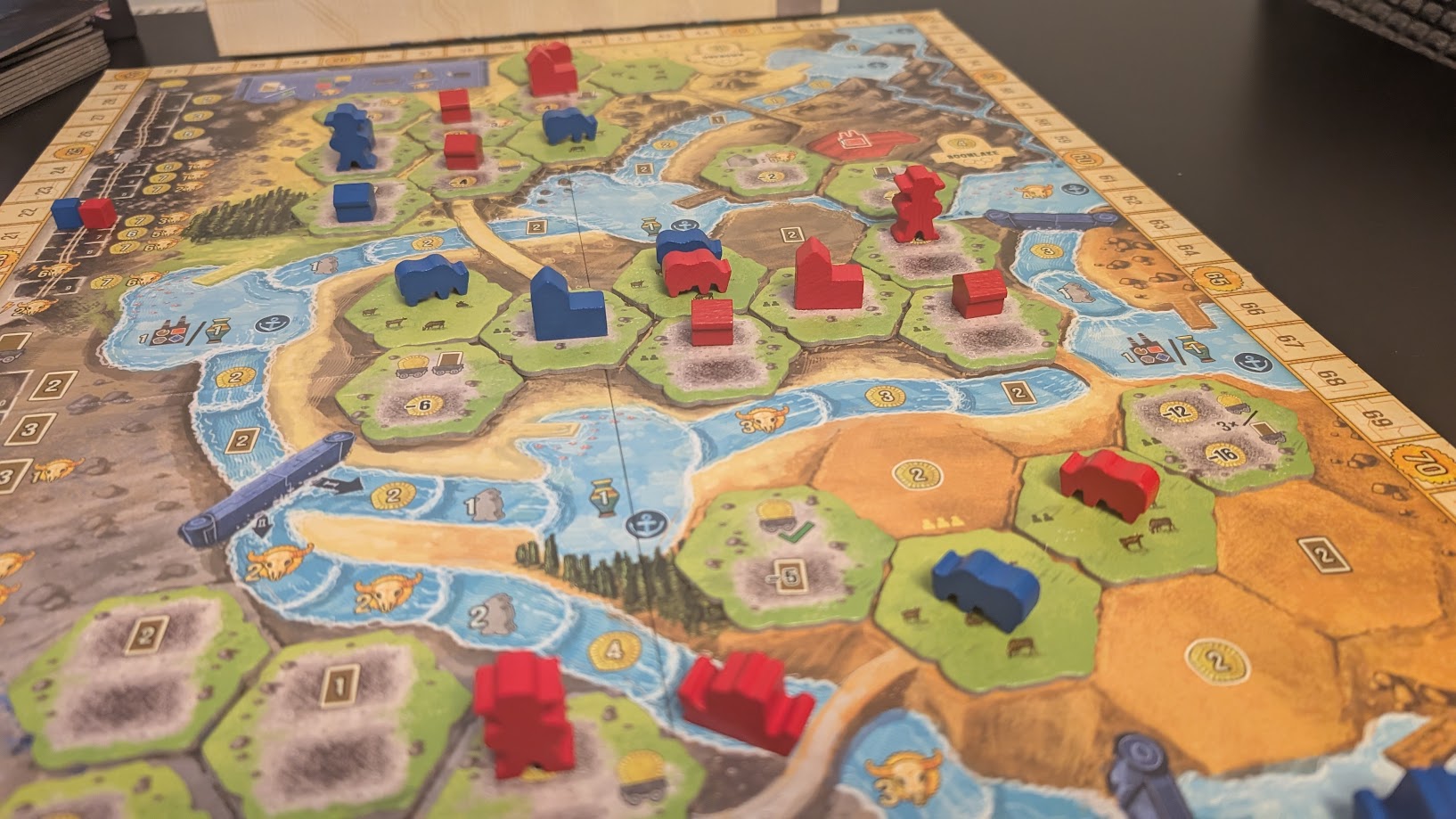
| – – CONCLUSION – – BOONLAKE is a big game with a lot of moving pieces. Most of it’s mechanics grind gently against each other but never get stuck, and it throws enough rewards at players that they’ll never feel at a loss to do something. The action selection is a standout for me and, depsite the odd choice of theme, I absolutely love the quirky cartoony art across the cards and boards. It’s often a long game, but never one that outstays it’s welcome, and it keeps me coming back for more. |

Review #0216
 Always Play Blue