| PLAYERS | TIME | DESIGNER | ARTIST | PUBLISHER |
|---|---|---|---|---|
| 2-8 | 15 mins | Luca Bellini | – | Dotted Games |

METHOD
Sometimes it’s nice to sit down with a new Lego set, put on some chill music, and enjoy a peaceful afternoon of putting the little bricks together.
BRICK LIKE THIS! says no to peace and relaxation. Now you build against the clock as teams compete to build something abstract out of Lego. And as if the presure of speed wasn’t enough, you won’t be able to see what you’re building, and must instead rely on the power of instruction from you teammate.
Ready, set, build!!!
POINTS OF INTEREST
Lego. But as a party game. How the heck does that work?
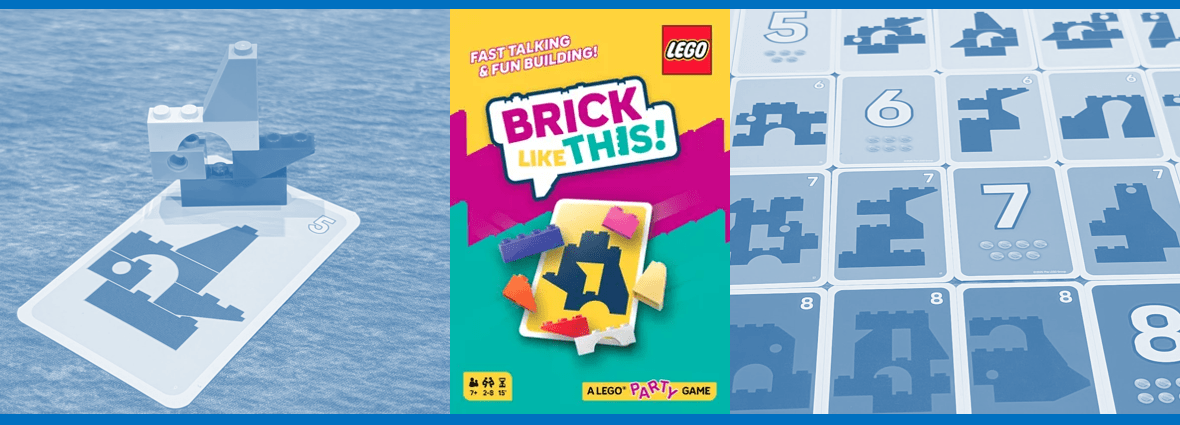
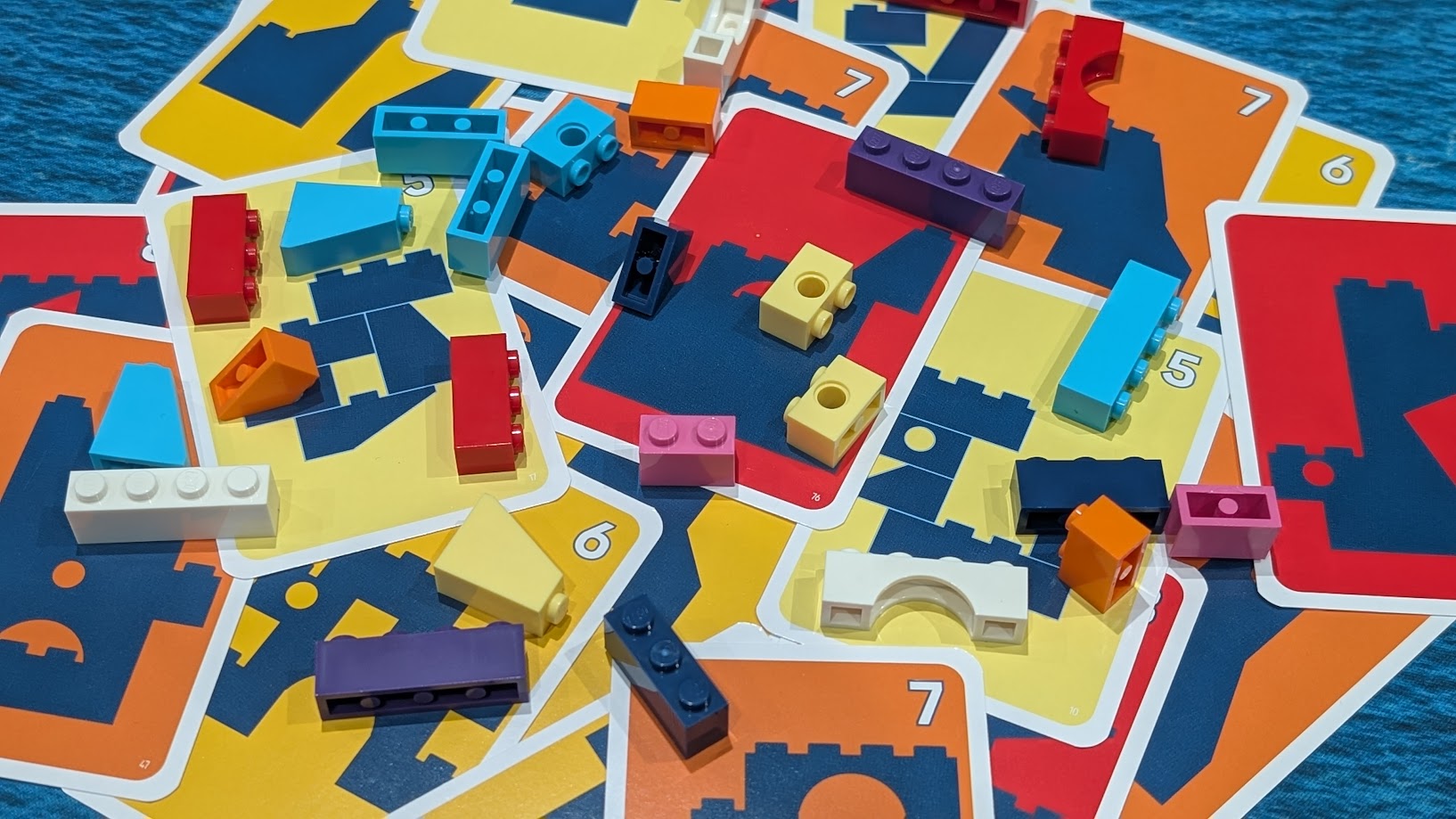
Well, quite simply, this game is a building race. Players divide into teams of two, with one person being the builder, and the other being the instructor. The instructors each take a card from one of four piles which differ in points pay out and build complexity. When everyone is ready, the build begins with the instructors calling out Lego pieces with size, shape, and colour descriptions as quickly and emphatically as possible.
But the builder picking up the correct piece from a shared pile of small Lego blocks is only doing half the job. The instructor must now get their teammate to connect it to the rest of the build correctly based solely on the 2D silouette only they can see.
When the first team completes their build, a timer is set for 30 seconds. Anyone still going after that is out of the round.
That’s right. This is a party game. A noisey party game
And it’s a lot of fun.

The cards themselves are worth points between 5-8. Overconfidence will lead some players to grab those 8pt cards and nothing else for the whole game. Over the prescribed six rounds, that’s 48pts. But if your build partner is struggling with you instructions, or if the player with the card gets flusters when under preasure, those 8pts can quickly become zero at the end of the round.
At the other end of the scale are the 5pt cards. These are not only the simplist shape with the fewest pieces involves, but the card also aids the instructor by showing the outline for each individual piece, making it much easier to see what goes where.
The game is a lot of chaotic fun. People will be screaming at each other across the table during these six energetic bursts of construction. And when that egg timer flips over, that extra pressure squeezes players harder and cranks up the stress. 30 seconds can disappear in a heart beat when your team mate won’t just listen and “move that bloomin’ white block over to-“
What makes the building a small challenge is that the things you’re building aren’t anything other than abstract. If the final build was a 2D representation of a car or a mouse, builders might click to it and start deducing where Lego pieces go.
But these random shapes make zero sense to the human brain, and a confident player can never try to get a step ahead of the building process. It means that the commincation between teammates must continue right down to that final piece being in place.
The main game is merely building against the clock for the most points and it would be fine left as this. But the designer or publisher decided to add a little extra sauce to the proceedings with interesting challenges.
As well as the points you get on a build card, you can make things a little more difficult for your team to rake in thoese extra studs. This can be useful if you’re lagging behind, or benificial if you want to put your decent lead further out of reach.
And what fun challenges they are. How about the builder has to close their eyes? Or build the entire piece under the table so that their teammate has no idea what they’ve done so far? And wouldn’t it be more difficult if the builder couldn’t use their thumbs? Or the instructer couldn’t use numbers or colours?
Suddenly that team who think they are Lego buiding gods are brought down a peg or two. And more importantly, it brings a lot more silly to proceedings by cranking the difficulty up several levels.
Will the game offer an entire evening of Lego chaos? Probably not. But it’s purpose is to warm up the gaming table, or to give your brains a mental chill between those larger Euros you enjoy. And there is no language dependancy, so this game is great for anyone and everyone.
ROOM FOR IMPROVEMENT
Of course, if you don’t like noisy, chaotic games, then this is clearly not designed for you. While everyone probably knows Lego and can be hooked into playing via their experiance of building with this most loved of generational crossing hobbies, it’s a panic enducing game first, and a Lego related product second.
Players who don’t enjoy people trying to be heard over other people, or don’t enjoy doing something quickly under changing time contraints, need not apply. This is for 4-8 players to let loose and come away with laughs.
And it’s a family game more than anything else. The points you get for the builds are too close together, ranging from 5-8 (without the challenge cards providing extra). This means that you could possibly be out of contention by the half way pont if you have a bad start, but more realsitically, everyone will be close by the end, making it difficult for ‘skilled’ players to feel like they are challenge to the others at the table. It leaves players keeping pace with what ever cards others are taking, or maybe just going one level higher for a round or two so as to clinch the victory by a slim margin.
The simplicity of the game left me somewhat lacking when it came to the builds. It wasn’t just the small points difference in the cards that bothered me, but the range in complexity too. I would have loved the red cards (the highest level of challenge) to perhaps be 3D builds. That would have been impressive. As it is, the sillouettes you are building all start blending into each other. I’d have also liked a bigger mix of pieces, but Lego itself isn’t a cheap license, and more bricks or larger pieces would have bumped the cost of the game up.
EXTRA CONTENT?
The game is a fairly new release, so there isn’t anything in the way of expansions at the moment.
What could possible expansions look like? Maybe more complex builds with bigger pieces. Or extra party modes where certain things needed to be built (like a cat, for example) with one player not knowing the goal (somewhat like A FAKE ARTIST GOES TO NEW YORK, but with Lego).
FOR 2-PLAYERS?
Although the game does have a 2-player variant, it mostly feels like a bolted after thought to appease couples who find that they don’t have two other people to play against. It’s a beat-your-own-score method where you take turns building while the other instructs, and try to score the most points in 10 minutes.
It’s fine, but I can’t see people having the itch to play a game and one of them suggesting to “beat that high score we managed last weekend”. Despite what the box says, this is a 4-player minimum.
| – – CONCLUSION – – BRICK LIKE THIS! is a very enjoyable party game. The Lego brand will definitely gain more eyes on the product, but what’s under the hood does what it needs to in a fun and silly way. It’s all about the silly, fun, chaos that errupts around the table, and it’s absolutely a case of the more, the merrier. |

Review #0217
[ Review copy supplied by Asmodee UK, obtained through Mason Williams PR – thoughts and views are my own ]
 Always Play Blue