| PLAYERS | TIME | DESIGNER | ARTIST | PUBLISHER |
|---|---|---|---|---|
| 1-4 | 45-60 mins | Richard Garfield | Cam Kendell | Alea |

METHOD
A meatier than usual Roll ‘n’ Write game that sees players delving into themed dungeons in search of treasure while avoiding dangerous monsters.
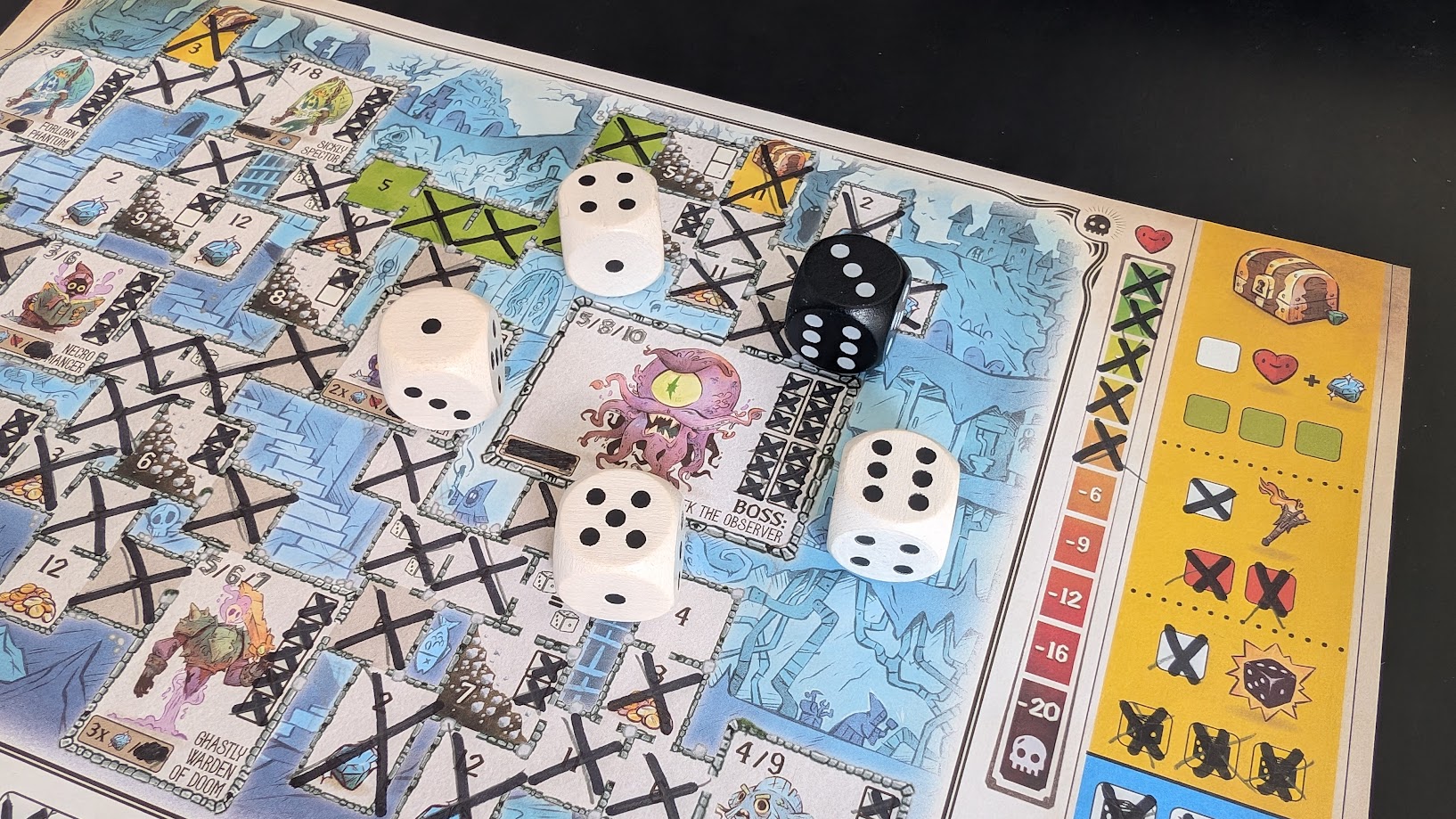
Players roll five dice, but only the active player can use the single black die on their turn. You then pair the numbers up and cross off adjacent rooms on your map as you push deeper and deeper into the dungeon.
The further you reach, the greater the reward . . . and the greater the danger.
POINTS OF INTEREST
How do you make a simple game of crossing off number boxes interesting? Richard Garfield decided to rearrange those boxes into a dungeon layout, entice players with treasure, and then litter the rooms with various iconic monsters.
You had me at Dungeon.

What this layout does is put up road blocks to slow the player down and make them think about each and every dice result. You’re making your way from the edges of the dungeon and working towards the final boss located towards the centre of the map. Other than the green marked ‘starting’ squares, you can only cross off numbers if they are adjacent to already crossed off rooms. Around the edge this doesn’t cause too much hinderance. But the further in you make it, the more restrictive this becomes. And if you can’t cross off two boxes each turn . . . well that’s how you lose health.
A lack of mitigation can be annoying in dice games. So how does DUNGEONS, DICE & DANGER solve this issue? It gives you a handful of dice and asks you to do some simple math on each turn.
There are five dice in the game; four white and one black. The active player rolls the dice and then all players pair up the results to give them their two numbers for the round. This adds an extra layer for those AP folks out there because you’ll be left with a bunch of possible combinations and you’ll want to work through them all to find the most rewarding end result.
And then there’s that black die. The active player can use the black die in place of a white dice, giving themselves an extra number between one and six to play around with. That’s not to say it’s completely off limits to other players. Everyone starts with three check boxes that they can sacrifice so as to use the black result when it’s not their ‘turn’.
This dice mechanic means that there is, more often than not, something you can do. It might not be much, but it saves you from taking a hit and racking up minus points come the end of the game.
More mitigation comes in the form of treasures. Each sheet has two treasure chests located somewhere on the map. When you reach one you are rewarded with the choice from three buffs. Extra health (meaning you can take a few hits before losing points), torches (good for clearing rooms when you don’t roll what you need), and extra black dice (giving you an extra three uses of the active die). These treasures might not be the most important thing in the dungeon, but they sure as heck shouldn’t be neglected. Each one comes in handy in it’s own way.
On top of all the fun of running round a dungeon you’ll have to content with a bunch of vicious creatures. Okay, vicious isn’t really the right word to describe them. Passive is probably closer to their role in the game. You see, most of the creatures hiding throughout the dungeon don’t actually fight back. Only the boss steals health from you, and that’s only from the player that slays it first.
But the creatures are still super useful to your exploration. They require multiple dice results to take down, thus giving you somewhere else to spend dice results. Great if you can’t move to a new room and it’s the only place that a ‘4’ can go.
They also offer big rewards to the player who fells them first, putting a race slant on attacking the monstrosities. Many a time I’ve wanted to place a number for a room but seen that I can end a creature before my oponent and take three gems before them.
And to keep things interesting, the game comes with four different maps. While the exploration premise is the same with rooms and monsters just in different gusies and configerations, each dungeon has it’s own theme and extra scoring conditions.
‘Annoyed Animals’ has you crossing off certain marked rooms with double results while also trying to link up your two starting areas on opposite sides of the map. ‘Puzzled Pyramid’, on the other hand, has players fill in a few numbers pre game on portal spaces and then be rewarded for crossing all eight off the list. It all mixes things up nicely and you’ll probably find a favourite from the four after a few plays.
ROOM FOR IMPROVEMENT
That AP (analysis paralysis) is real though. From around the mid point you will be staring at the rolled dice and trying to go through every combination availble to see what is most effective on your map in that moment. Or, worse, you’ll be desperately trying to find that one combination that will prevent you losing health. It’s not game breaking in any way, but if you play against people like me, you might have to endure a fair few long pauses between turns.
Something that takes me away from the theme a little is the constant jumping around on the map. Because you can start in any green square at any point, you’ll end up with about five or six entrances into the dungeon. This means that, on your turn you might be crossing off two rooms on opposite sides of the dungeon on the same turn,. This seems to skip over the feeling of being an adventurer making their way into danger and more like a small group all moving around randomly. Not game breaking, but it’s one of a few things that brings the ‘game’ up above the ‘theme’.
Something else that does this is that the monsters are available for other players on their own maps after a player has slayed them. Sure, the follow up players get a lesser reward. I guess it’s more that a player has knocked the creature out, and when someone else reaches them, they are a little weaker and have less treasure to take. But there are times that we’re fighting the same beast at the same time. Again, it’s miles away from being game breaking. Perhaps it’s just a way to make the game more family friendly so that no one truely misses out on something if they are not the most efficent player.
The biggest issue with the game is the rulebook. Check the BGG forums and you’ll see comments about how bad the translated rule book is. It leaves several questions that you’ll need to hunt down the answers for (I think there is an unofficial fan FAQ now). For such a simple game, it drops enough confusion in to occasionally bring proceedings to a halt, especially around the end game. A real shame that the game doesn’t have the love that it deserves from it’s publisher as it’s an almost hidden gem of a game that could do better with the right support.
EXTRA CONTENT?
To date there is no extra content for the game. It would be as easy as adding more Dungeon maps and mechanics, much like PAPER DUNGEONS did.
FOR 2-PLAYERS?
I don’t think you lose much playing this at any player count. The difference between a full 4-player game and a 2-player game would be the amount of times you can use the active black dice. A 2-player game offers more freedom in this respect, and we don’t have a lot of turns we can’t go until the final stages.
| – – CONCLUSION – – A nice middle ground in the Roll ‘n’ Write genre. More complex than simply crossing of boxes like GANZ SCHON CLEVER, but not as brain busting as TWILIGHT INSCRIPTION or HADRIAN’S WALL. And it comes with a nice fantasy theme that keeps the game fun and interesting. All it’s missing is some character progression. |

Review #0208
 Always Play Blue