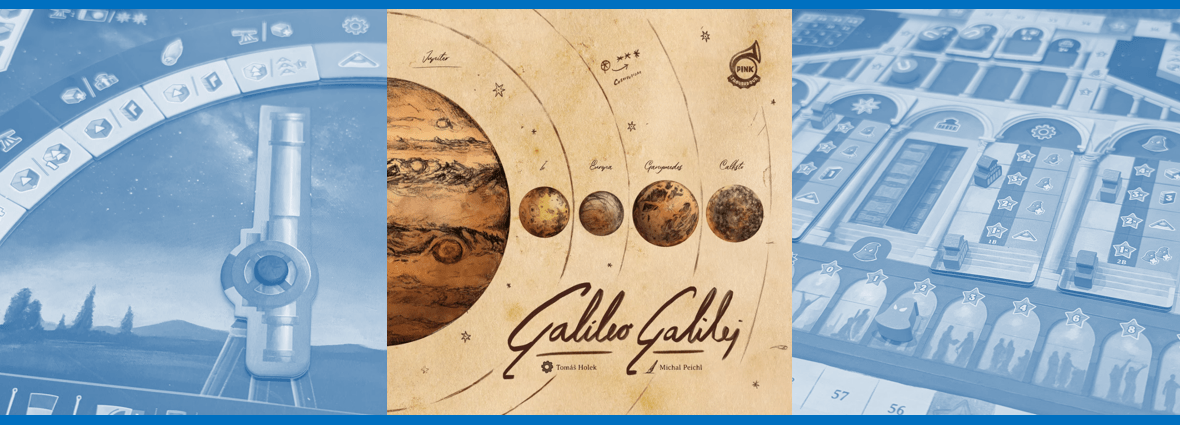
| PLAYERS | TIME | DESIGNER | ARTIST | PUBLISHER |
|---|---|---|---|---|
| 1-4 | 50 – 100 mins | Tomas Holek | Michal Peichl | Pink Troubadour |

METHOD
Players are astronomers in the 16th century, using their telescopes to spot planets and constellations.
Each turn you’ll move your rondel telescope and select a pair of actions. Increase your knowledge in the university, discover unknown planets and new star systems, and avoid the watchfull eye of the inquisition.
POINTS OF INTEREST
I wasn’t sure what to make of this game when I first saw it. The art style of the iconography seemed at odds with other art in the game. The rondel system seemed a little gimmicky.
But, after my first play, I was hooked.

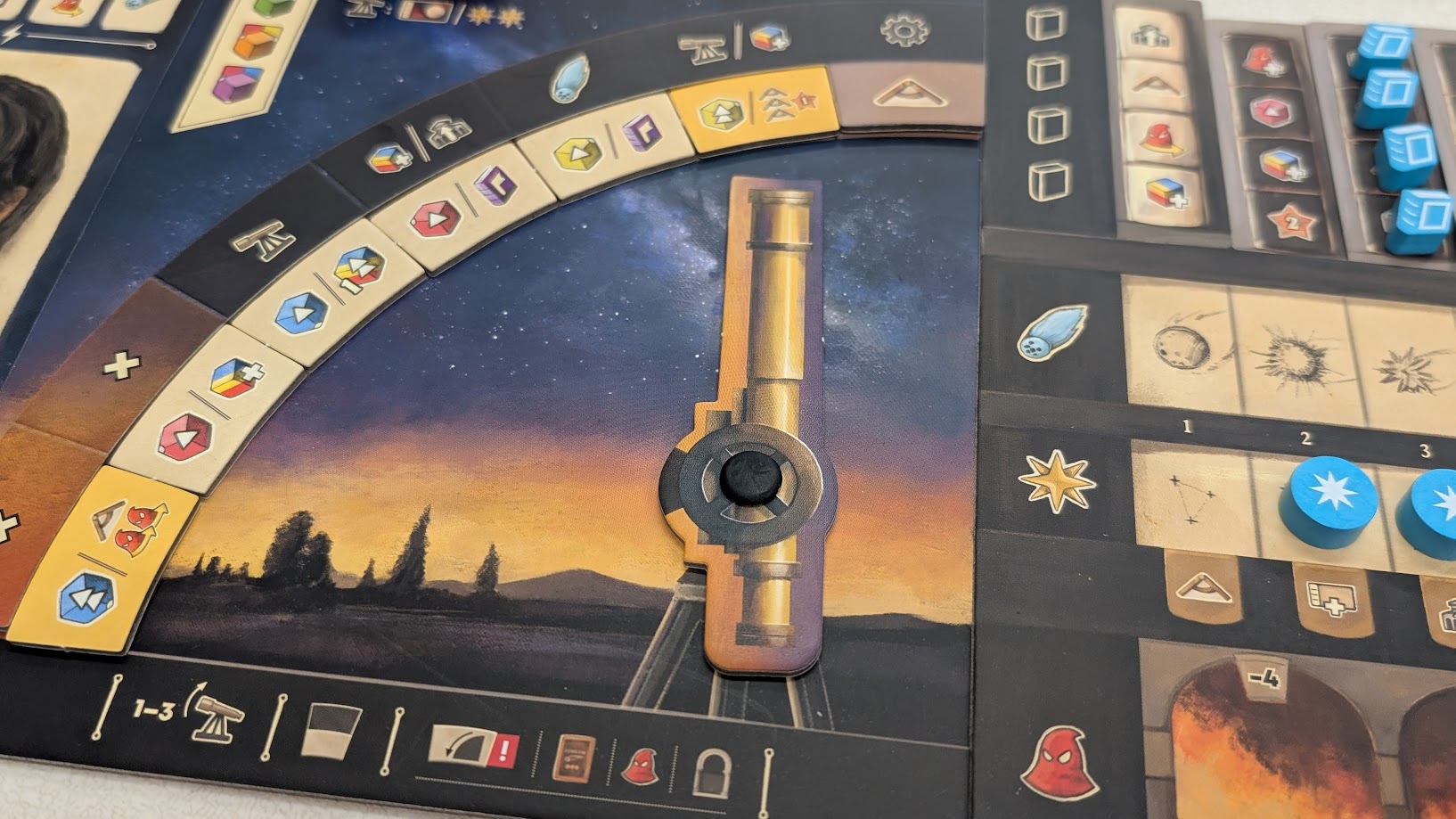
The rondel action is interesting. You have your telescope and it can move up a number of spaces or return to the lower space and go from there. You have two action tiles to use on your turn, but the inner choice is constantly changing. Every time you take your action, the inner action tile is taken out and placed at the bottom space on the rondel. The shuffles things along so that a different action tile is sitting on the permenant action space when you come back around to it.
Better still, those inner action tiles can be upgraded. It sounds simple, but it adds so much to the choices you make each turn. Because you can’t access the lowest two spaces on your rondel, an action you choose now will be unavailable for a minimum of two turns. And that’s if your telescope can reach it on the turn it makes it back to the first available space. And then it might not be pair with an outer action that is useful this turn.
So many changing conditions to your action selection. If you can plan for it, you’ll do very well. Me? I can’t handle all the calculations to be efficient. I just go with the flow, turn by turn, and it works out pretty good.
But what of the obsevation of celestial bodies. This is a game based around Astronomy.
Space. Planets. Stars!!!
Well that’s all here too. When you carry out the observation action, you choose between spotting far of constellations, a quick and easy action with small requirments. Or you go big and discover a planet which requires more work on your part to accomplish, but will give you bigger short term requires, and a few long term ones too.
The game uses dice, but these things aren’t made for rolling. Instead they track your astronomy skills. Red, blue, and yellow. You’re limited to four dice in total at a time, and can never have more than three of the same colour.
To observe a constellation you need a single dice as a cost, matching the value or higher to place a token on the matching space of a card. This gives you points and maybe some other bonuses. The token you used also comes from a spot on your player board that gives you a reward. But the card stays on the main board. It’s not yours.
If you want to claim the card (and you will want to get some, for sure), then you’ll need to discover the planets. This requires a minumum of two dice as you’ll need to combine two primary coloured dice to gain a secondary colour to claim one. The numbers to complete a planet are also higher, especially as you get to the level 3 cards later in the game. And while you’re not placing a token to gain extra bonuses, you do get bigger points and get to place the card in your library section which becomes usful later.
Oh, and there’s even some value mitigation, thanks to another action you can take that sets one of your comet tokens on the main board. These are brilliant. The first time you place one out, it becomes available to you on a future observation action to add to the total of your dice. Use it once and it moves to below the planet cards and becomes a 2. Use it again on a future observation action and it goes to the comet book space where, at the end of that turn, it can be placed on one of a limited number of reward spaces.
This game is very ‘rewarding’.
This game has so many small moving parts, and that’s all before we get to the university, a whole other section on the main board.
Here, you’ll move one of your four university tokens up a track. At each step is a reward (usually, but not always). The point of these tracks is to gain lots of end game scoring. Each game, six random tiles get shuffled, with four being sorted to go on top of the four tracks. These represent different aspects of the game like library cards, inquisition meeples, board ungrades, and so on. The higher you get up a track, the better the multiplier for that specific mechanic.
So, if you get to the top of a track that rewards you for having inquisition meeples in your basement (sounds weird, but I’ll explain that in a momnet), then you could get an extra 3 points for each meeple at the end of the game. But if you make no progeress on the track, you get zero. So you’re going to want to prioritise moving up those tracks that you’re doing well at to make them count for more.
The university also has extra scoring section at the top of the board that is more first come, first serve. In set up, the remaining two university tiles flipped over and place in a top spot. The first person to accomplish each of these goals (along with two other available goals that are always perminent) gets to place ascoring token at the top spot for seven points at the end of the game. Anyone else can still accomplish it, but they get the reduced prize of just three points.
Overall, these sections of the game, the planet cards, the university, and the player’s libraries, all work together to keep small rewards coming in, with most actions you’ll take as a player usually being chosen not just for what you want to do, but which bonuses time well at the same time.
Some of these delicious extras can even combo, giving you nice extended turns where this spot moves that token which offers this reward which moves that other token. Every now and then you’ll get a little spike of excitment with a fun little combo turn, and it’s moments in a game that make playing enjoyable.
ROOM FOR IMPROVEMENT
The biggest issue I have with the game, though it’s something that is fading with each play, is the Inquisition.
On my first play, it seemed both incredibly fiddly but something you needed to be very careful about in case it got out of hand. Instead, it’s not as difficult as I’d expected, or indeed hoped, to move the Inquistion meeples along.
Certain actions will cause you to gain members of the Inquisition, red meeples that acording to some, look like dark wizards. These get placed on your player board in an area affectionatly known as ‘the basement’.
Placing a visiting member of the Inquisition is fine. He’ll just sit there in the far left space, with the gentle promise of minus eight points at the end of the game. But a few spaces across from him, over to the right is a spot that offers positive points for each meeple there. So that’s where you want him to be, right?
It’s the moving of these meeples that offers a small puzzle. Every time you move at least one, you have to do a little math with all the Inquisition meeples you have on your board. There are four spaces on your basement section, three of which are marked as negative points for movement, and only one that is positive. To be clear, these movement penalties are seperate from the end of game position penalties. But stick with me here.
So you move just a single Inquisitor, and at the end of your turn, you do math. Two Inquisitors are in a minus two spot, and three are in the coverted plus one space. So you total is minus 1. You then move a seperate marker on the main board, left of right depending on negative or postive. Here we would move our hood token left one space.
And guess what. This marker also resides on a track that is negative and postive points at game end.
But there are a lot of ways to get your Inquesition meeples moving, and in big enough steps that you can suffer very few negative points. And you can get a decent amount of points if you have a gaggle of them in the far right space of your board at the end of the game. This will also mean that your hood token will be far to the right too, which is more points.
But it’s not the head scratchy puzzle I expected it to be. Moving them isn’t too difficult. Holding off until you have enough movement to count on a positive hood movement isn’t too difficult. Avoiding getting them until you’re able to handle it better isn’t too difficult.
That’s not to say you can just relax and flow through the whole process of them, or even ignore that mechanic completely. But I wanted something crunchier like the Golem / Student relationship in GOLEM.
Usually, for this section, I find things that are more mechanically broken or represent poor production. This, though, is more a me thing. It’s a mechanic I expected more from. But after several plates, it’s not as strerssful as it first presented itself. You may have no problem with this, and it in no way breaks the game or lessens my enjoyment of the game. It’s just me.
After a few plays we went onto the asymetric abilites. The base game is fine for a few plays, by I do like adding asymmetry to things for that extra layer. However, I did find that one of the four characters (Johannes Kepler) is pretty much useless comapred to the others. In fact, I actively avoid him now. The small amount of juggling needed with his ability to move another action token in and out of your rondel just doesn’t seem to have the weight of the other characters.
Giodano Bruno gets a better basement tile (my favourite asymetric ability and one that sort of fixes my previous issue with the Inquisition). Galileo Galilei gets an extra observe action (easier to shift those observation tokens). And Nicolaus Copernicus does some interesting stuff with the book area of your board. These three have a little meat on them and can have players leaning across the table when you do something special.
On a side note, I’m keen to see what abilities are coming with the four new characters of the Luna expansdion.
EXTRA CONTENT?
There is an expansion due this year that adds four new astronomers and a new mechanic to the game involving mapping the moon.
As it stands, GALILEO GALILEI isn’t a game I’m playing and wishing it had more to it, but because it exists, I’m now keen to see what the expansion adds to the base game.
FOR 2-PLAYERS?
The game works just fine at 2-player. The amount of planet cards is reduced during setup so the pace of the game moves about the same. Nothing is blocked off other than a handful of the bonus comet spaces. Time between turns is the only thing that might bother some with added players.
| – – CONCLUSION – – GALILEO GALILEI looks more complicated at first glance, but the simplicity of its actions slowly emerges after early plays. A game with four main sections to play around in, the action selection Rondel is best in class as it implements a method to avoid the staleness of a static board. The random set up for the university also helps keep games fresh with the combination of scoring goals varying each game. One of our favourite games of 2025. |

Review #0213
 Always Play Blue