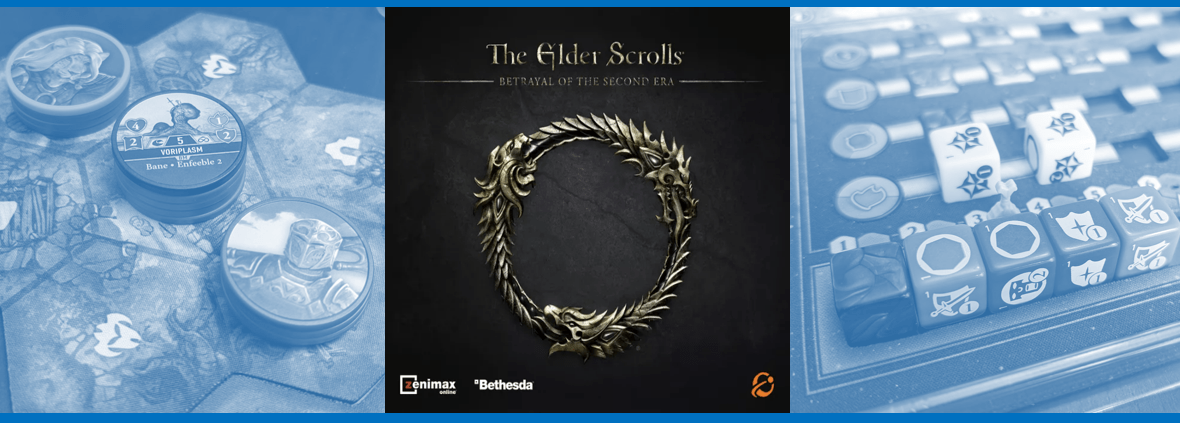
| PLAYERS | TIME | DESIGNER | ARTIST | PUBLISHER |
|---|---|---|---|---|
| 1-4 | 120 – 240 mins | Josh J. Carlson Michael Gernes Logan Giannini Ryan Howard Salem Scott Josh Wielgus | Chris Beck Yoann Boissonnet Anthony LeTournaeu Federico Pompili | Chip Theory Games |

METHOD
Deluxe board game publisher meets best selling fantasy video game series in this epic production that will engulf your game table and have you carving out a weekend of your time to get stuck into a plethora of adventure and exploration .
Players build their characters choosing iconic Elder Scrolls races and then mix in fun to play classes and skill lines before heading out into one of several well known Tamriel regions.
And all the while you are working to uncover and prevent the plots set in motion by the villainous Deslandra.
POINTS OF INTEREST
Chip Theory Games came to my attention when I stumbled upon TOO MANY BONES. Here was a game that prioritised deluxe components alongside its gameplay and mechanics. As a lot of reviewers pointed out, this game is near indestructible.
It intrigued me. But while the gameplay and mechanics tried to pull me in, the theme and setting were something I wasn’t sure about.

Flash forward a number of years. I’ve gotten more into the amazing hobby of board gaming while Chip Theory Games have followed up their iconic game with other deluxe hits like CLOUDSPIRE and BURNCYCLE. They were always on my periphery, but the settings still weren’t a draw for me, not when the up front cost was so high. Don’t get me wrong, a more reasonably priced version may have seen me dip my toes in. But to step into the Chip Theory world was a big ask and still nothing had me hooked.
And then they went and molded their TOO MANY BONES mechanics around the world of The Elder Scrolls, and I knew there and then, that I was finally going to see what all the Chip Theory fuss was about.
Unboxing this project was a moment I will never forget. You can view hundreds of component photos and sit through hours of YouTube content, but you just don’t really get how Deluxe things are until you hold them in your hands.
The hefty box sat on my table as I pulled laminated maps, laminated cards, neoprene mats, poker chip enemies, hoards of dice, and much, much more, all while smiling with glee.
Of course, you could say that this deluxification coupled with my love of the IP may cloud my judgement here. You may scroll down to the score and figure that I’m just going to rejoice in this game like a love sick teenager. And maybe I will. I can tell you now that a lot of praise is coming. But I’m fair, and the ‘Room for Improvement’ section further below will not be left empty.
But lets get on with the good stuff first.
I guess we should get componets out of the way. Deluxe doesn’t do these things justice. The weight of the character poker chips makes moving your pieces around the maps feel really good. The neoprene player mats are a delight to house your pegs and action dice. The Gazettes are thick tomes that guide you across your chosen region with missions and locations.
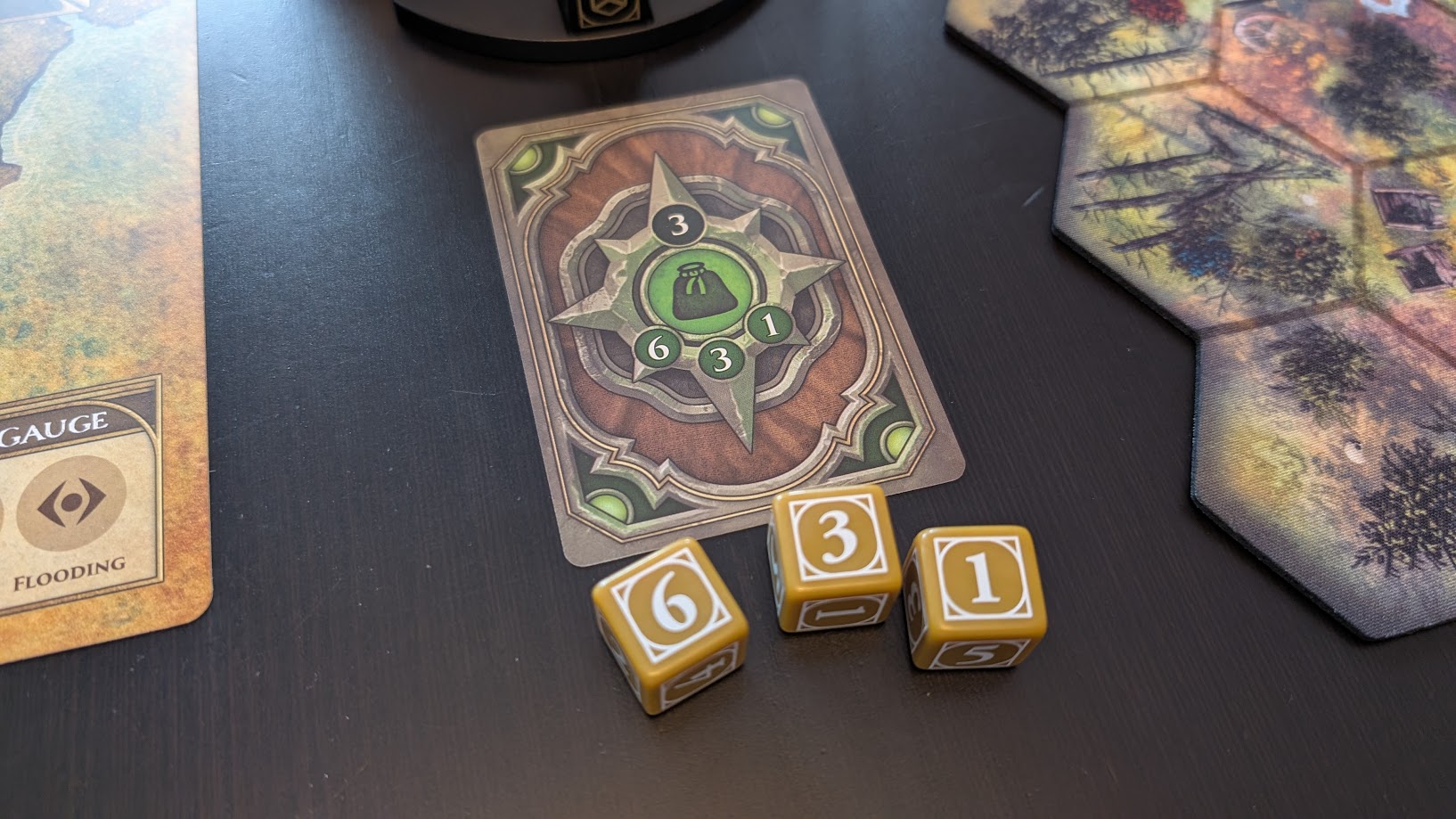
Some games have deluxe components, but they are usually an island in the middle of a sea of average. Here though, everything you handle in the gameplay is at the top of it’s game. Cards you will never need to sleeve, player mats that you could spill a drink on and not care, and more dice than any one person could ever handle.
And this is just the base game. This came from a crowdfunding campaign that offered even more touches on top with a beautiful and oversized dice tray, more weighted health chips, and small binders to hold every sheet and card related to you chracter.
Deluxe doesn’t make a game good. But it makes the gameplay experience feel like an event.
But what of the gameplay itself?
Well it’s a mix of parts that all work together to help you adventure and battle your way through a mini campaign of sorts.
That’s right, this is a campaign game. Technically. And thankfully, a resetable one. You’ll pick a region (either from the base game or from the expansion(s) available) and begin in a town on that regions map.
Your chosen quest will require you to head out on the hex map and take care of what ever business is required from you. This is session one. You have (usually) twelve days to get something done, culminating in a big fight. Along the way you can get sidetracked with mini quests, battles, and delves, all while gathering more skills, more items, and more importantly, more XP. Use this to add more dice to you character to make youself more effective against whatever is to come next.
Get through session one (which isn’t guaranteed by the way) and you’ll hit session two. Here, once again based on your quest, you’ do mostly the same sorts of things, either in the same region, or more likely in another. Get this done and you end up in session three.
This reduces down to just three ‘days’ where the first two mostly allow you to prepare for the final big (big, big) fight.
Once you’re done, win or lose, that’s it. Everything goes back in the box, and then the next time you play you choose different characters, a different region, and a different quest.
And there are so many combinations of regions and quests that the replayability for this game is astounding. While some things may feel a little familiar, the quests we’ve done have had us using all sorts of locations and mechanics. But there is more. You could play Marshwood three times with three different race, class, and skill cominations, and each play would feel completely different.
THE ELDER SCROLLS: BETRAYAL OF THE SECOND ERA is an expensive game, mostly down to those high end components. But because there isn’t a one and done campaign, and because there are so many routes through the stories, it can be something that is played for a long, long time before you get close to repeating yourself in outcomes. And those Deluxe components are tough enough to last through that experience.
Something that differs from the amazing video games is that limitations on leveling up. With a tight restriction on play time, you won’t be able to go ‘Skyrim’ by taking your time to level up every single aspect of your character. Time is tight across these quests, and you’ll have to plan with ruthless efficiency how you’re going to accomplish each of your scenarios.
XP does not come thick and fast, and when it does come, it comes at a price. XP is spent on several things like gaining better dice for your skill lines, increasing your dice refresh amount, and bumping up your health, magic, and stamina stats. Worse still is that there is a cap, which prevents you from saving up large amounts of XP to then splurge. Sometimes you’ll have to use it or lose it.
And another complication comes in to play when building your character throughout the campaign. You have a total of 8 skill lines on your player mat. Three get taken up with health, magic, and stamina. That leaves five. But wait; four sit opposite four. That doesn’t leave much wiggle room!
And that the beauty of this game. Tough choices sit waiting at every step. So, you grabbed the ‘Two Handed’ skill line and want to get good at it. But the only line you have free now sits opposite you health slots. So a choice comes down to do you want to have more health to take more damage, but deal out less with ‘Two Handed’, or do you bulk this fighting skill up, leaving your health low which will definitely bite you on the butt on the battle field.
And these tough, crunchy choices come just with upgrading your character. Wait until you get to the region map and battles.
So. Many. Choices.
The region maps are their own little fun puzzle. You have spots that you have to reach, with the game advising when the latest you should reach a location is. That means that trudging across these maps is it’s own littleefficiency puzzle. Not because you need to count out a certain amount of hexes, but because there are distractions, good and bad, littered along the way.
As mentioned above, XP isn’t growing on trees. And there are ways to get it in town quests or battles. But you’ll often find that these points on the map aren’t just laid out in front of you in a neat little straight line between point A (where you start) and point B (where you need to go). That would be far too simple.
It all becomes a planning session of what do we need, how much time do we have left, and what can we risk. Because going into a town or stopping to fight bandits doesn’t mean you’ll definitely get that XP that you crave. You might even walk away from a fight in worse condition.
It’s a travel puzzle, and a delightful one. And it’s a fantastic feeling when it all works out.
So, that’s characters and traveling. That just leaves the battles themselves. Here is where you build neoprene dungeons, sit you character chip atop a (hopefully) impressive stack of health chips, and then wade into a fight you might win, but will come away from definitely feeling it what ever the outcome.
Here Chip Theory Games moves away from their set grid lane battler set up from TOO MANY BONES, and keeps going with the hex maps.
Enemies will be pulled from bags based on mostly simple maths calcualation (this part had me scratching my head for the first few games), populate them on the tiles, and then go to war.
This too becomes an efficency puzzle. Here you know the rules of each enemy and must move, position, and attack using your abilities as best you can. There are moments when you’ll have to take hits to allow a better move on a future turn. Or perhaps use one player to lure an enemy to a spot so that Player 2 can unleash a mega attack.
Sure, when you usually play games like this they include two things missing in THE ELDER SCROLLS: BETRAYAL OF THE SECOND ERA; random enemy actions and minis (or at least standees). But here, it’s all part of the puzzle as your hardened fighters use their knowlege of these enemies to ‘predict’ where enemies will go. And as for the minis/standees, this is something that fades away very quickly once you start moving stacks of weighted chips arcoss a hex map like you’re a croupier at Monte Carlo. Trust me.
Mix all that together and you have an epic weekend of gaming where you grow and grow you character, take on tougher and tougher challenges, and step up to a final fight (hopefully) before packing it all away.
I was originally a little sceptical about this rinse and repeat short campaign style for the game, but after several plays it’s really grown on me to the point of it being my preferred way to play games of this ilk.
You see, one thing that slows down our runs of big box fantasy campaign games like GLOOMHAVEN and AGEMONIA is trying to keep everything running in the ongoing story. All while trying to remember what new mechanics and unlocks were introduced weeks or (more likely) months ago. It makes the return to a campaign like FROSTHAVEN feel like homework just to get everything, and everyone, back up to speed.
But with THE ELDER SCROLLS: BETRAYAL OF THE SECOND ERA, not only do you get that high from reaching a finale over several occasions, you’re always starting the short campaigns over, meaning your learning curve is better with little in the way of new mechanics being introduced. Instead it’s just new content; items, locations, skills. Stuff that’s fun to take on board.We’re still in the early days of our enjoyment of ths game, but I would not be surprised it we surpass the play time we put into a complete campaign of GLOOMHAVEN, a game we loved and got so much out of, but which now sits in a land fill some were, it’s completion merely a memory of good times we shared with it.
Here though, we can always return, to play as new character combinations, and create new memories, over and over.
Is the game expensive? Damn right. But it doesn’t have an end date, which makes it so worth it.
ROOM FOR IMPROVEMENT
Yes, I spent a lot of money on this game. Yes, it’s based on an IP that I love. Yes, it’s a feast for the eyes when set up on the table. And yes, I could dispense praise on this game all day long.
But it’s not perfect. Here are a few things that make me wince just a little, despite my high rating below.
I get that the box is already bloated with content, and asking for more enemy chips to be included would only enlarge the price tag and the strorage solution that would be required. But it can be a little immersion breaking when you dive into a bandit hideout to fight a bandit . . . a mudclaw . . . and a Troll, all working together as a team. When I sneak into a Bandit hideout in the video game, I usually fight a whole bunch of bandits.
The game unfortunately has only a single chip per type, although there are variations of Bandit (High Elf bandit, Wood Elf bandit, Orc bandit), but this is just a general example. You could say the same for Skeletons. There is one, but I’d expect walking into a crypt to find many.
Speaking of enemy chips, these things are covered in icons that the hard of sight might struggle with. This is fine once you get used to what is their health, their attack, and their armour.
But what takes the most time in any battle, is the constant referencing of enemy abilites. Every enemy is different, and each has a unique combination. When fighting three enemies, you might have to keep refering to nine different abilities on the reference sheet. It’s distracting admin in the middle of what should be a tense and interesting skirmish. I wonder if all enemies should have abilities. I would have perhaps expected key higher level villains to have extra touches to the basic ‘move and hit’, but here every thing, even rats and crabs, have something you need to be mindful of outside of them trying to beeline towards you and cause pain.
Which, on a larger scale, leads me to the biggest of the enemies; Deslandra. You see, she is the big, big bad of the game. Always. No matter what region you visit, no matter what quest you tackle, all roads lead to Deslandra.
For a game that revels in it’s replayability and mix of paths, it was odd that it always comes down to her. I’d have preffered a different big bad per reqion at the least.
And boy, are those final fights tough. For us they are the least enjoyable part of the campaign. We absolutely love the exploration and questing of the first two sessions, but this final fight sees the complexity, the mechanics, and the difficulty, go through the roof.
We often go into these final fights somewhat perplexed by what we need to do in such a way that seeking that ideal plan of attack becomes a crapshoot as we become quickly engulfed in gangs of high level enemies.
We’ve never finished a campaign and felt that our time was wasted, but the final session sees us sometimes just accepting an outcome we can’t always seem to get around. This is perhaps the negative side effect of all that replayability though variation; it can be hard to practice and improve when it’s different each time.
And one final gripe, though it’s not from me, but more for others. This is a beast to set up, play, and tear down. You will need time and space to really enjoy this game. It’s a consideration you’ll need to keep in mind.
Like most Chip Theory games before it (TOO MANY BONES, CLOUDSPIRE, and BURNCYCLE) this is a lifestyle game. You could play it once a year on that one long weekend you’ve set aside, but to really get the most out of it, you’re going to want to invest (time and money) into everything it has to offer. For some this is too much of an ask. But for the rest of us, it’s an experience to be repeated and relished.
EXTRA CONTENT?
The base game released with a region expansion for Valenwood. This offered an extra map to explore with some more enemy tokens and items.
As at the time of writing, there is a Gamefound campaign running for more expansion content. This includes two new regions (Elsweyr and Sommerset), extra race variants, some Daedric quests, and as the much anticipated Vampire and Werewolf skill lines.
With a game this big, I would not say that any of this is neccesary. The base game is already full to the brim with content and replayability. It would take someone many plays to exhaust what comes in just the main box.
That said, if you like the game enough, you’ll probably want everything there is to enjoy the full Elder Scrolls experience.
[this section will be edited once I’ve tried out the expansion content, currently expected early 2027]
FOR 2-PLAYERS?
The game scales pretty well with player count. Adding more players keeps the danger level matched nicely, but it adds a lot more play time. For us, we play exclusively at two due to time and play space and it works just fine. Some later scenarios can get a little tricky with only the two of us, and you can miss out on a nice spread of skill lines with this limitation, but we’ve never played and wished we had more people around the table with us.
| – – CONCLUSION – – A game of epic proportions in almost every aspect, THE ELDER SCROLLS: BETRAYAL OF THE SECOND ERA is definitely not for everyone. But look past the lavishness, the cost, and the time sink that it requires, and there are hours and hours of enjoyment to be had in an adventure game that really asks you to think about every little decision. And what’s more, it doesn’t demand an extended one-off investment from you. Instead it gifts you with repeated experiences with potentially no end in sight. |

Review #0214
 Always Play Blue