| PLAYERS | TIME | DESIGNER | ARTIST | PUBLISHER |
|---|---|---|---|---|
| 1-5 | 30-45 mins | Rick Holzgrafe Isaias Vallejo | Mihajlo Dimitrievski | Daily Magic Games |

METHOD
Each player is using resources to add buildings to their growing village while also attracting adventurers, all in the hope of being named the new Capital City of Valeria!
The game uses a basic action selection mechanic where the active player chooses one of the five available actions and each other player can ‘follow’ for a less impressive version of that action.
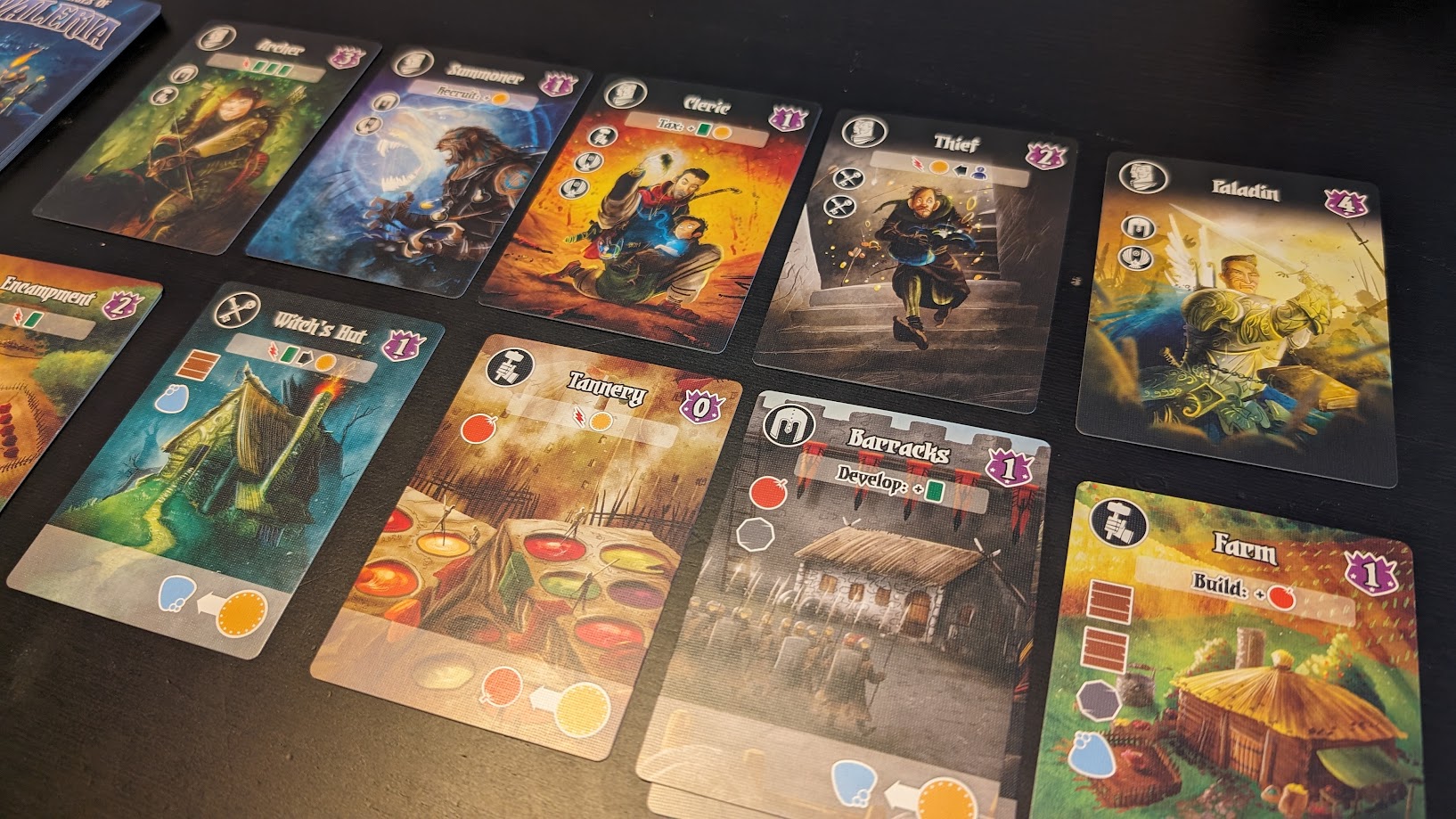
Building cards have two uses; they can be used as their building to gain a one off bonus when placed, or to give an ongoing abilitiy each time it’s criteria is met, or they can be rotated to add a useful resource to your kingdom which will make things easier to build in future rounds.
Players keep adding Buildings and Adventurers until target number of cards is reached by a player (based on player count) and then the game ends. Most points wins.
POINTS OF INTEREST
Among the larger entires of the Valeria series like SHADOW KINGDOMS OF VALERIA and CASTELLANS OF VALERIA, there are some smaller entires that have much fewer components and play a lot simpler.
VILLAGES OF VALERIA is one such game. Other than the gold tokens and the castle action marker (all made from wood) everything else is done with cards. It gives it a smaller footprint when compared to it’s bigger brothers and makes it quite simple to teach.
Much like venturing into the Medieval trilogies by Garphil Games, the entire Valeria series from Daily Magic Games uses the same artwork and same icons across each entry. As you step from one game to the next you’ll be comfortable within the eco system as familarity reassures you.
Being a small box game makes VILLAGES OF VALERIA a great entry point into the series, despite being cronologically further down the line.

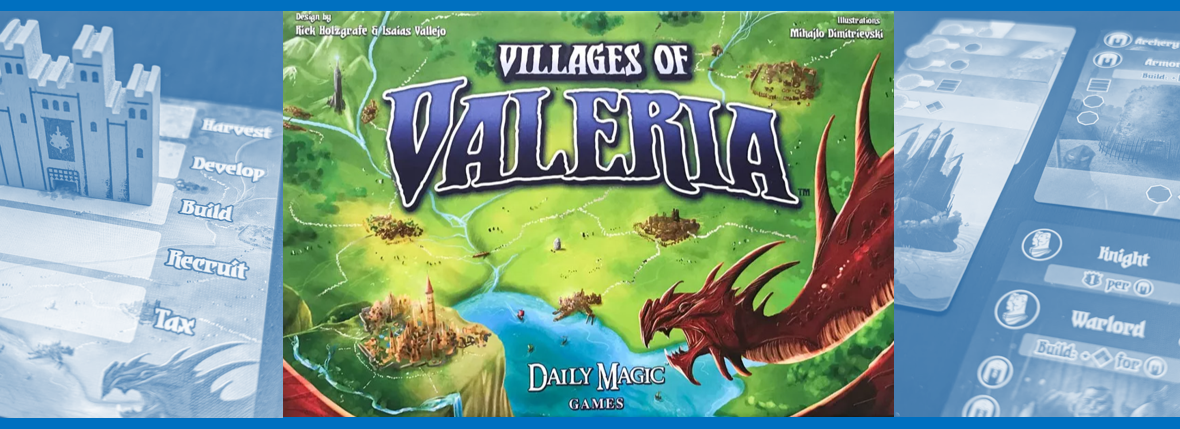
Each turn the active player places the wooden castle on the action selection card. Here there are five choices; Harvest, Develop, Build, Recruit, and Tax. That’s it. That’s your lot. Of course, five actions might feel like a lot to new players, but based on what your resources are on a turn will already dictate if you can even carry out these actions. So your choice is simplified.
- Harvest will gain you more cards to hand, useful in a game where cards can be used as a ‘sort of’ resource to trigger certain abilities.
- Develop lets you remove a card from you hand and place it beneath your Village, making it an available resource for the rest of the game. You’ll need these.
- Build is the most important action, the core of the game, really. You’ll place a building card from your hand into your play area, paying it’s resources first. There’s a lot to consider when placing a Building, especially as you can’t have any duplicates in your Village. Buildings not only come with end game points, but a mix of either instant or ongoing abilities.
- Recruit let’s you bring Adventurers from a seperate market to your village. These also have their uses, including more of those scrumtious end game points.
- And finally Tax, which let’s you gain gold. This will be spent to activate those resources, you know, the ones you need to build stuff.
But the action itself isn’t the only thing to consider when planning your turn. This game takes a page out of TINY EPIC GALAXY’S book by employing a ‘follow’ action.
Each time the active player selects an action, and only once they’ve finished their turn, each player in clockwise order gets the opportunity yo carry out a budget version of that action. This is a great little touch. First, it keeps all players engaged in the game, even out of their turns. But it also lets you accomplish more, just as long as you have enough coin and resources.
Sometimes you can jump on a Develop or Tax action if your opponents trigger it, freeing up your next main action to use the benifits of your follow. It’s a great mechanic, one that lets you stay on the ride for the duration instead of constantly jumping on and off just to take your own turn.
Something I really like about this game is how the gold and Village resources work. You’ll start with one resource of your choice, plus a wild resource. When you use these resources, you cover them with a gold coin. This leads to a couple of things that you’ll need to pay attention to throughout the game.
As you add more resourse cards to your village via the Develop action, you’ll need to make sure you’ve gained enough gold to be able to cover them up when the time comes to use them (gaining is done via the Tax action). However, if you don’t have the resources you need to Build, you can place a gold token on an opponents village. Of course, there is a negative that comes with this, but also a positive. You see, when that player refreshes, you won’t get that gold back. Instead, they add it to their pile of cha-ching. You’ve effectivly paid them to use that resource.
But what of the postive I mentioned? Well, it’s not a massive thing, but because players don’t refresh until the start of their turns, that gold will sit and block the resource until then, effectivly preventing that player from accessing it during all the ‘follow’ actions that preceed their actual turn. It doesn’t sound like much, but it can be a nice little kick in the gut if done at the right time.
And so the game carries on. Main actions and follow actions, each player racing to hit the target amount of cards in their village to trigger the end game with the most points. The actions themselves are quite quick, and with the follow action included, it really gives the game very little downtime. The five actions are super basic and distinct too leading to a game that’s extremely easy to get your head around.
ROOM FOR IMPROVEMENT
Something I didn’t quite get at first was the action selection card. It has the five actions printed on it with space to place the wooden castle. I assume this is to show what action has been taken by the active player each turn, allowing all players to see immediatly which follow action they have access to.
However, my first assumption was that it meant you couldn’t use the same action striaght after another player had used it. I thought that the castle had to be moved to a new actions, something enforced upon me by the ‘follow’ action because that’s how you would get around being blocked.
But you can do the same action over and over between you. If the resources allow it, you could keep doing the same action. There is nothing wrong with this, but it made me wonder what a more cutthroat version of the game would be like. Without it, VILLAGES OF VALERIA can feel a little ‘friendly’ and relaxing.
It’s also a race game of sorts, and sometimes a player can find it hard to catch up with the first person to get a building down. The points on cards don’t vary too much, making it hard to save up for a big move that might take the lead towards the end of game. It’s a game that really benifits a player who can plan their turns efficiently between those follow actions to make the most of everything they have.
And, while it’s great for beginners, it’s more simplistic approach leads it to be more for fans of the series in the long run. If you’ve come from the biggers games in the series like GUILD ACADEMIES OF VALERIA, this one can feel like a step back, more of a ‘My First Valeria’. This doesn’t make the game worse, but gives that same feel of playing a decades old video game franchise in reverse order.
EXTRA CONTENT?
There are a bunch of blister pack expansions available for this game, each including a handful of cards for each card type, and / or adding a new rule set for the game. They don’t really add too much extra to the game and would probabaly only be useful to players who have a lot of games under their belts. Nice additions, but in no way necessary to the enjoyment of VILLAGES OF VALERIA.
FOR 2-PLAYERS?
We’ve only played at 2-player and it works just fine.
At most, I can see more players meaning that you’ll get more ‘follow’ actions, but because you’re limited by your available resources which only get refreshed at the start of your turn, I don’t think you’ll be able to do something on each other players turn.
Cards would also get cycled through the two markets (Buildings and Adventurers) a lot quicker, which is both good (keeps the market fresh) and bad (that card you like the look of might not hang around for you).
Overall, 2-player doesn’t have any extra admin, and it plays at a nice pace.
| – – CONCLUSION – – VILLAGES OF VALERIA is a great side order game within the series as a whole. It’s best use is to get new players into the series, or to fill in the gaps for that Valeria collection. We mainly use it as a filler game between larger fair. It takes the ‘follow’ mechanic from other games and adds an interesting resource system to make it stand out from other small box card only games. |

Review #0204
 Always Play Blue