| PLAYERS | TIME | DESIGNER | ARTIST | PUBLISHER |
|---|---|---|---|---|
| 2-4 | 30-60 mins | Mat Hanson | Edu Valls | Inside Up Games |

METHOD
Players suit up as adventurers embarking on a thrilling and dangerous expedition into a frozen temple.
This is a Pick-Up and Deliver game where the routes are constantly changing from turn to turn as players and events alter the tiles . . . and even the direction of the board itself.
Pick up Idols, use them for research, or drop them to gain abilities that will make things easier for you. The race is on.
POINTS OF INTEREST
Okay, lets get one thing clear upfront; this game is absolutely gorgeous.
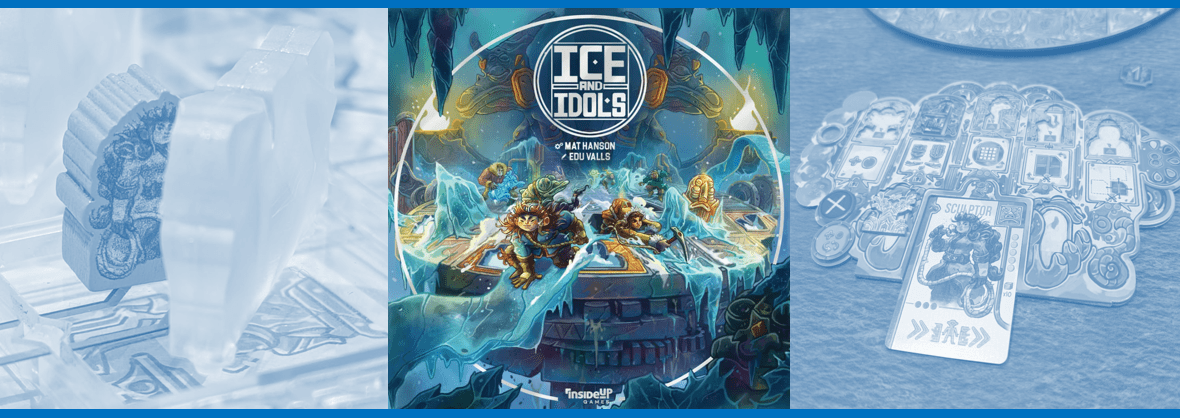
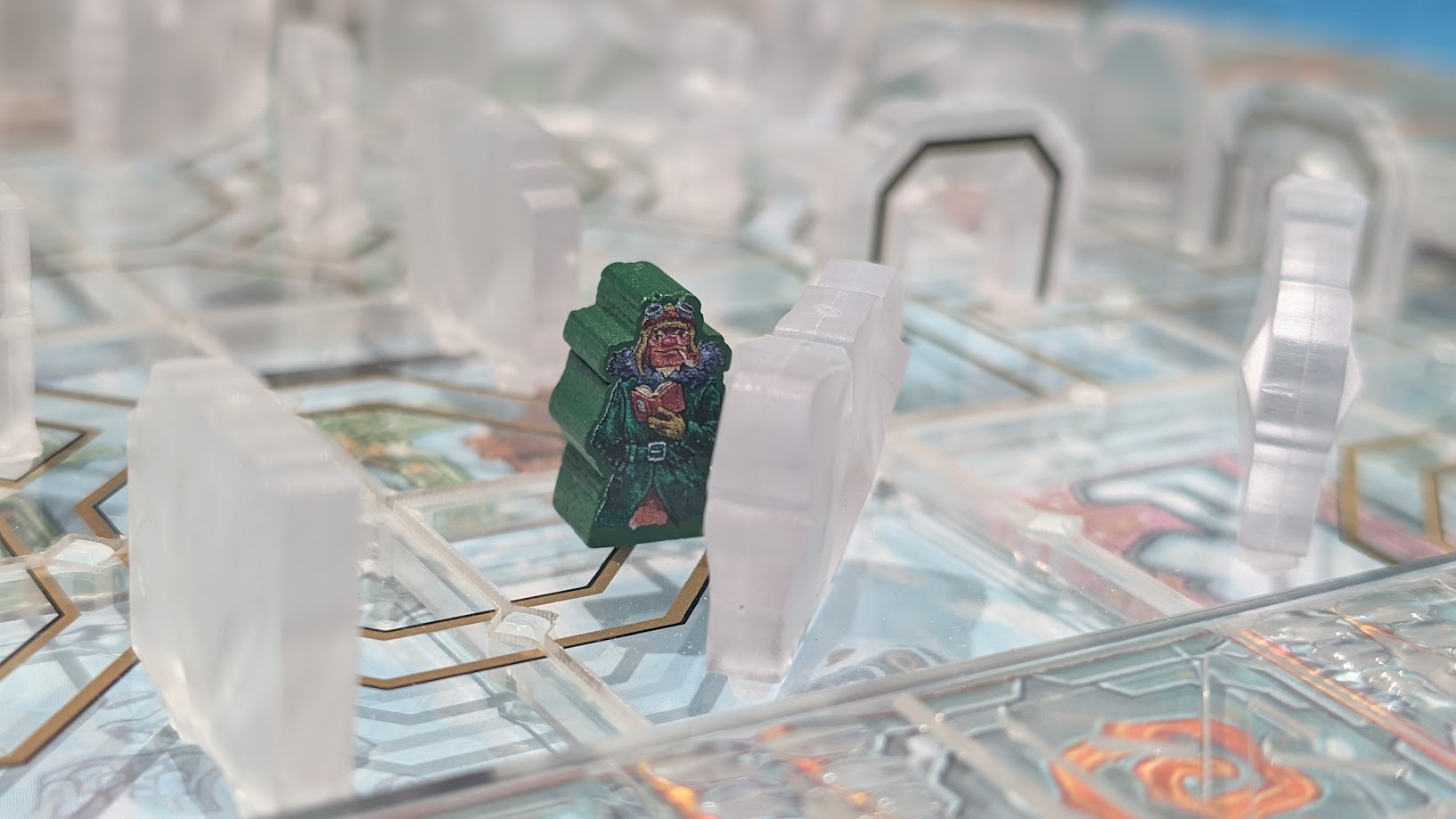
When I opened the box for the first time I discovered a succulent feast for the eyes. From the stunning plastic components that make up the ice temple, to the beautiful artwork across the player boards, ICE AND IDOLS immediately screams table presence. I have no doubt that heads would turn if you had this set up at a convention open gaming space.
But, as we know in this hobby, looks don’t make a game good. So, is ICE AND IDOLS plastic fantastic, or is there more under it’s chilly exterior?

At first, the game seemed perhaps a little simple. On your turn you have five whole actions to get stuff done and it’s just picking up idols and placing them down again.
Five actions may sound like a lot, but it goes quickly if you need to cross from one side of the temple board to the other. It is only a 5×5 grid, after all. The main mechanic behind the game is grabbing these Idol tokens and using them for one of their two purposes. But picking up and putting them on their matching location are each an action.
So the action economy in this game is tighter than it first appears. Some turns can be super quick as all you do is scamper along the marked routes to reach your necessary destination.
Players zipping around a board in this manner could get very boring, very quickly.
Thank God the that the board isn’t static then.
One of the highlights in ICE AND IDOLS is its toy like functionality that comes with the make up of the temple board itself.
The first thing to know is that the 5×5 grid is made up from twenty five clear plastic tiles that ‘float’ above the board displaying the Idol icons. Players and events can causes these tiles to turn, slide, and sometimes vanish. This is where the chaos rears its head.

Players can no longer relax when they get to within spitting distance of the space they were aiming for. Will it still be there on by you next turn? Maybe. But who knows where you’ll have been shuffled off to. It’s great for keeping players engaged between turns, having them cross their fingers and toes, hoping that no one else draws an event card. Dear God, let me still be in the same space next turn. Please!
And this amount of board manipulation is just the tip of the iceberg (yeah, I went there). Because not only are the tiles available for manipulation, but so is the board!!!
It’s basically a lazy susan, and when it gets rotated 90 degrees, it can be heartbraking. It’s basic math and psyhics that the further out from the centre you where, the worse the change in game state might juts be for you. And you were so close too. Oh well.
But how, in all this chaios, do you get stuff done? Well, that’s a good question. And it’s where the Idol rewards and asymetric player abilities come in.
When you drop an idol to it’s matching location under the temple, you are given a choice. You can chuck it back in the pile and place a cube on its matching research track to claim some points, get a bouus reward, and move things closer to the end game trigger.
Or, and hear me out, you could lock it into your gorgeous dual layered player board and unlock a new ability. Each player’s board has the same five unlockable powers, each matching the colour (and shape) of the five Idols. Want an extra action for the rest of the game? Grab that Blue Idol. Want to be able to rotate the board when it suits you and only you? Better get that Green Idol. Or maybe you want to speed up your delivery times with some extra carry space? Then it’s the Brass Idol you’ll want.
Not only does having the full set get you extra points at game end, but these abilities can really come in clutch multiple times, helping you out while occasionally screwing over everyone else.
Add to that the four characters you can play as that each come with an individual ability, and you’ll have no excuse to be stuck on the spot, unable to move. You have the tools, now go use them.
And yeah, like I said at the start, the game is gorgeous. The player boards in particular are some of the best I’ve ever had put before me. Dual layered, clear icons than doesn’t lose any of the quirky art style, and a slot for everything to fit in perfectly.
This game is just an overall pleasure to play.
ROOM FOR IMPROVEMENT
But of course it’s difficult for a game to be 100% perfect, and ICE AND IDOLS comes with a couple of small ‘flaws’ that make me wish for a few minor tweaks.
What stops this game getting my highest score all comes from the same source within the game; the research track.
The track serves three purposes in the game:
- First, it marks the end game trigger.
- Secondly, it offers more points.
- And finally, it is used in conjunction with Key cards, end game scoring bonunses that are based on the patterns of your cubes on said research track.
Now, I’ve got no problem with the board being used for the end game trigger. Once everyone has filled their player board slots, all other Idol drop offs will lead to this board and it’s five tracks, and this will ramp up nicely, putting pressure on players to fill the empty slots before it’s too late.
And points aren’t the problem. Mostly. I like points in a game. I think we all do. But the balance of the Research board isn’t clear when it comes to how much the spaces on each track are worth, mainly because the points tokens for each column get moved around. A lot.
Couple this with not all columns being made equal, with the central green column being two spaces taller than the outer blue and gold ones, with no real tactical reason that I can see, and it feels like a missed opportunity to have players going for one track over another for tactical reasons.
Maybe the green colum is slower, but worth more, something fixed by having the points locked in and only rewarded when it’s full of cubes. Could this have been linked to having the Green Idol harder to pick up and/or deliver? Maybe.
But I wasn’t a fan of the column points being manipulated constantly.
It’s a gripe. A small one.
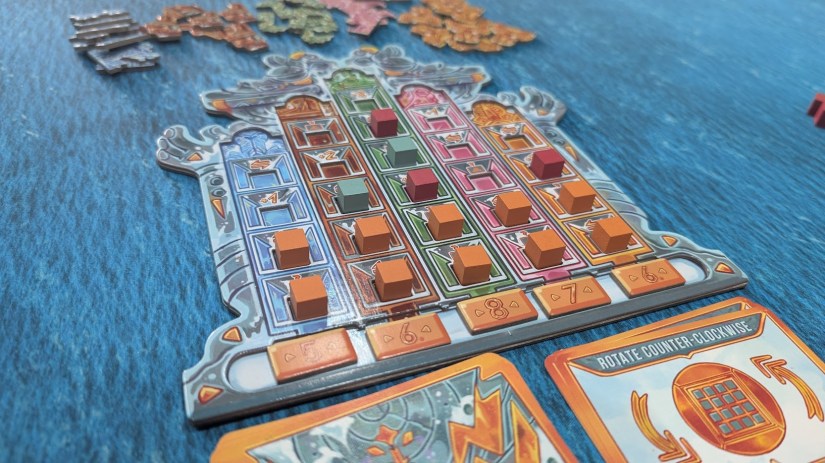
Something I felt tarnished the end game were the Key Cards. These are end game scioring cards you get at the start (just one) and they require you to have your coloured cubes in certain layouts on the Research Track.
First of all, this one card feels like an unnecessary thing bolted on. Having three cubes in specific spots is an extra concern that lost me a little, adding hesitation and frustration.
It was made worse in the 2-player only game due to the bottom two rows of the board being blocked off, and the top of the tracks being tapered. Halfway through one game I found myself unable to complete my card due to a single cube placement from my opponent.
Don’t get me wrong, I like the basics of the Research Board, but there were a few things in it’s execution that took me out of the experience and left a sour taste in an otherwise fantastic board game.
Are these irks game breaking? Absolutely not. Can they be house ruled? Easily. And it’s a testiment to the game that these negatives don’t have me walking away from the game, instead wanting to ‘fix’ it. Because it is overall a unique and fun game, one that makes me yearn for my own copy.
EXTRA CONTENT?
The game has no expansions, modules, or any kind of extra content.
FOR 2-PLAYERS?
The game works pretty well at 2-player. There is a little less chaos in the board manipulation, but things still get moved around when you least want them to due to how many symbols on player boards and the research track make players draw event cards, which is good.
If you want a slightly less stressful play of ICE AND IDOLS, one where things change, but not by much, then 2-player will serve this up nicely.
As mentioned above though, I feel that the research track suffers a little when it’s reduced down, partly because of the layout of it, and partly because of the associated scoring cards.
| – – CONCLUSION – – Despite a few flaws that I have with the game, it isn’t enough to remove the shine. ICE AND IDOLS is a gorgeous and exciting Pick-Up and Deliver game, with excellent playability deriving from its ice temple components and ever-changing board state. The production value is high with this one, and the gameplay backs it up to make ICE AND IDOLS a great entry into the Pick-Up and Deliver genre. |

Review #0221
[ Review copy supplied by Inside Up Games, obtained through the UKBG Review Circle – thoughts and views are my own ]
 Always Play Blue