
| PLAYERS | TIME | DESIGNER | ARTIST | PUBLISHER |
|---|---|---|---|---|
| 1-4 | 40-60 mins | J.J. Neville | J.J. Neville | Split Stone Games |

METHOD
MYCELIA is a game where players are growing their mushrooms across an expanding board of triangular tiles, sporing cubes to aid in extending their network to reach the right tiles and grow even more.
But it’s not all relaxing forest floor gardening.
This game can get pretty cutthroat as players block opponents spaces and use (aka steal) opponent’s spore cubes so as to be the dominant mushroom kingdom.
POINTS OF INTEREST
I was fortunate to play a demo copy of MYCELIA back in 2023 and I was immediately intrigued by it’s area control mechanic and constant growth and regrowth of the mushroom pieces on the board. To set the stage accurately, I know nothing of Mushrooms, and I don’t exactly get on with nature. But I do know enough about board games to recognise a good one when I see it.

On your turn, you’ll carry out two actions from a set of six. Importantly you can’t repeat an action, which is something I really like in games. It stops players from rushing specific actions over and over, and makes you think a little more about what else you can add to what you’re trying to do on any given turn.
To start, each player has a Mother Mushroom sat on one of the central tiles. Think of this like your army’s General; it’s the top dog on the board and is the only piece that isn’t stationary. Use the ‘move‘ action and it can reach up to two spaces. So, while it’s not breaking any land speed records, it’s also not too sluggish. More importantly thought, it can control a tile that your opponent has a mushroom on. This effectively blocks that enemy mushroom until your Mother Mushroom moves away.
But why would you want to block an opponent’s Mushroom? Well, to answer that, we should look at some other actions.
The mushroom cards are the main thrust of the game and each has a few important things to note on them. An obvious one is end game points. But a number that really affects gameplay is their Spore count.
Sporing is very important. It’s an action that produces the game’s currency. Spore cubes sitting out on the tiles will be required to fullfil a mushroom card’s ‘fruit‘ requirements. For example, a mushroom might need four cubes; two from green tiles, one from a red, and one from a brown. You’ll need to have spored from your Mother Mushroom or one of your Fruited Mushrooms on previous turns to have these available and in the right place.
So, you want to ‘spore’. Great. There are three factors to this action, and you’ll only have control over two of these. Get ready for a some devious randomness.
First, pick a mushroom to ‘spore’. It’ll either be your Mother Mushroom, or one of your five other mushooms, if they are out on the board. Now you have your launch site. Next up, is the spore count (that number in the lower right of your card) that lets you know how far your spores will reach. Now you have range.
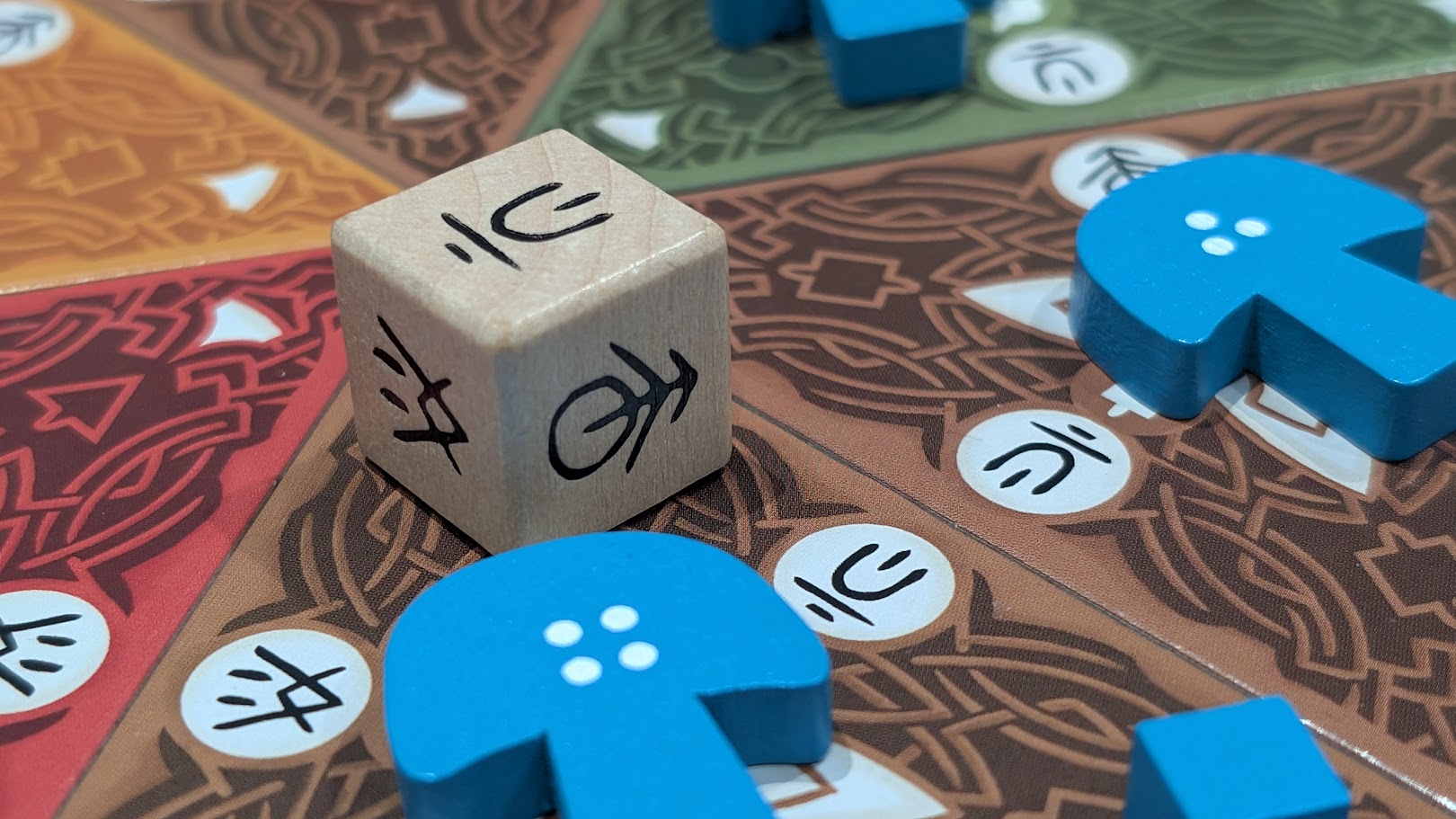
But it’s the targeting where things get a little loosy goosy. This is where lady luck steps in disguised as mother nature. You see, each triangular tile has three exit points (marked by symbols) and you’ll roll a dice to see which way your spores go. Basically it’s the wind, and it adds a thick layer of tension to a simple and very necessary action.
It makes the Spore action somewhat frustrating for the active player as their plans now sit before the doorway of chance. You’ll always have a primary direction that you’re rooting for. And, if you’re lucky, maybe another direction could allow for a decent backup plan. But what about that third direction? Doesn’t that lead right into your opponents network? Wow, you wouldn’t want your spores to go that way. It would be a gift to you enemy, rewarding them with currency for their own devious expansion plans.
Tick tock, tick tock. Roll those dice and see which way the wind blows.
Let’s say things have gone your way. You now have a bunch of spores scattered across tiles, and those tiles match the requirements of a really good mushroom card in your hand. Well, now you’ll want to choose the ‘fruit’ action.
This is where a big part of your network’s expansion will come in. You have five small boards in front of you and each holds a little wooden mushroom token. You want these on the main board so that you have more locations to spore from.
Each mushroom card you hold has spore cube requirements. When you ‘fruit‘ you will look to see where those required cubes sit on the board. But there are a couple of rules you’ll need to get your head around first, all relating to your network.
It can take new players a little bit to wrap their heads around this, but it’s not too difficult to get to grips with. Essentially, you coloured pieces make up your network. You have to be able to take spores from adjoining tiles that you control. Spore cubes on their own are fair game as long as you have a colour piece on the tile.
But their is a hierarchy to that control. A mushroom token controls the tile, meaning a red mushroom token could control other colour cubes that had been deposited on it. And a Mother Mushroom superceeds all.
This is important, and it’s what pushes the game into cutthroat area control. Networks can be broken with clever Mushroom placement or devious Mother Mushroom movement. What’s yours, might not be yours once another players decides to interfere.
You’ll have a hand of cards that you’ll want to get down, for points and for abilities (more on that in a minute), and sometimes another players spore cubes can be just within convenient reach that it really does make sense to use them. Which is why the ‘spore‘ action is so tense. Because it can put your spore cubes where you can’t protect them. It’s genius.
But it’s not all doom and gloom. Your mushrooms have a limited life span, and once they’ve spored twice, they aren’t much good to you. Sure, they hold your network together, but with no production capabilities, they’re essentially dead weight.
And that’s where the ‘decay‘ action comes in. Sure, it removes a stronghold from the board, but it comes with a nice little bonus. Each Mushroom card has an immediate or permanant bonus on it that you only get once you decay that mushroom.
The immediate bonuses are pretty good. They let you put more cubes down, add more tiles, or move things around. But the permant ones are much better, epsecially if you can get them down near the start of the game. They imrove your actions, making you much more effective.
Decaying also frees up one of your five mushroom slots, letting you work on the next card to get down and the next points toward victory. Because it’s the circle of life. They work, they die, and then more are born. It’s also the game clock. When a player has a card in each of their five decay slots, the game is over, immediately. This means that you’ll need to keep an eyes on your opponents boards so that you don’t get caught out.
For the astute out there, you’ll be counting along and now be asking “what about the other two actions”. And you’re right. I’ve talked about Move, Spore, Fruit, and Decay. Well, the other two actions are standard board game actions, things you’d expect. You can ‘discover‘, drawing a new card from either a display of three or blind from the top of the deck.
You can also ‘explore‘, taking a face down triangle tile and placeing it to expand the board out more. Maybe its that one colour tile you don’t have in your network. Maybe you can place it away from your opponents to give yourself a little breathing room.
And that’s the flow of the game. Turns are quick with just two actions. Players will do their best to expand and control their networks while nipping in and taking what happens to be laying around unprotected. You’re always going to want to use another players spores before you clear away your own. It just makes sense.
And that gives such a fun, take-that edge to the game as players move their Mother Mushrooms around to cut players off and take over tiles. And the more the merrier. A 4-player game can get ruthless quick with the limited space on offer. Maybe you’ll all try the peaceful route to start. But if no one expands, then conflict is sure to arise, and it’s the best way to play the game.
Finally, I’d be remiss for not mentioning the art. Where the game could have used a miriade of art styles and looked fine, the choice of the designer (and artist) to go with the nature textbook look was perfect. Each coloured sketch looks like it was pulled from a science book. What’s more remarkable is the lack of duplication and the amount of mushroom variety in that deck. Illustrating this game must have been a heck of a task.
Beyond that, the art style for everything else (the player boards, the triangular tiles) is standout unique. It has a sort of Celtic vibe to it with the curved lines. The colours too are perfect for the theme, with nice earthy tones across everything. It’s most definitely a game that draws the attention with it’s overall look and production.
ROOM FOR IMPROVEMENT
Okay. So there are a few obvious things that you might not like with MYCELIA.
The first is that wind dice. If you don’t enjoy your planned action being affected by luck, then you’ll probably find yourself quite frustrated when you want to spore in one direction and it goes in the other. Several times in a row.
And, outside of 2-player (see below), the game is going to get cutthroat. It’s the nature of the game (no pun intended). It might not look it from the theme and artwork, but it is area control after all. This is not a bad thing; it’s what makes the game interesting. But I know some people don’t enjoy that, so it might be off putting.
Something that I wasn’t quite sure about were the insect tokens. They amount to a couple of things. First, any you have left at the end of the game can be worth points. As most of our games were 2-player, where interaction was minimal, this is mostly what they amounted to for us. And we never really saught them out. We just picked them up when our Mother Mushroom was passing by.
But they have other uses in the game. Spend one and you can refresh the card market. It’s a free action, so you could refresh before taking the ‘discover‘ action. Useful if you’re on the hunt for mushrooms that you can actually ‘fruit‘.
You can also use them to move another players Mother Mushroom. Great if they are on top of one of your Fruited Mushrooms, hindering your ability to spore, or breaking your network. And it’s not just shove them to one side. You can catapult them across the board it you wish.
But their aren’t that many Insect tokens on the board that you could amass a nice collection to help mitigation regularly. Not all tiles spawn with a token. And in the higher player counts where they are more useful, the amount of available tokens is divided by more players, so you still won’t get that many.
You can purchase them, but this costs an exorbitant three cards! In this games economy, that’s expensive. I can see the point of the insect tokens, but I dont feel that they’ve been worked in to the game in the best way.
Another issue I had, and it’s a small one, merely me picking at the edges of a truely fantastic game, are the Decay rewards. The mechanic of gaining the rewards is fine, and I like what most of the cards do. But an issue I ran into a few times was the timing of it all.
I want to get a good engine going, but like most card based games, it’s all luck of the draw. Opponents can get an advantage early on because of what rewards they have on their Mushroom Cards. A couple of my games saw me get only instant rewards, a couple of which could barely be called a benefit in the early phases of the game. One game like this also saw the market have pretty much the same rewards.But if I held off on fruiting and decaying those mushrooms, I’m falling behind with my network and could find myself boxed in.
It’s a tough one, and not something easily solved. Like I said, I like the rewards mechanic as a whole, but sometimes it can be wasted.
EXTRA CONTENT?
At the time of writing, the only expansion available is the MYCELIA: NORTH AMERICAN EXPANSION. This adds a couple of things, both mechanics and components.
First up, for those who play with more people and want even more stepping on toes, is the fifth player set, including all the components (in purple) that you’ll need for a much busier board state.
Next up are the Saplings. These nice wooden leaves are randomly set upon tiles when they are revealed. When you later use the Spore action, you can chose to drop a spore cube on the Sapling instead of the tile. The pro is that it will give you a random bonus and open up the ‘age‘ action (more on that in a moment), but the spores that reside on a Sapling are no longer available as part of your network. They don’t connect things and they can’t be spent. By anyone.
And then there are the Grandfather trees. If your Mother Mushroom token sits on a tile that has a full Sapling (three spore cubes), you can choose the new ‘age‘ action to discard the Sapling and spore cubes to place one of your three available Grandfather tree pieces. Not only do these things give you five points each at the end of the game, but they form a permanant part of your network. And that’s not all. If you had one of your Mushrooms on the same tile at the time of using the ‘age‘ action, the Mushroom automatically Decays. And, if Spores ever land on the same tile that a Grandfather tree is sitting, the owner of that tree chooses which adjacent tile the spores land on. Nice if you need a specific colour and your opponent spores in your general direction.
The expansion is a very good add on and would easily add an extra point to my final score. The extra mechnics (Saplings and Grandfather trees) fit in nicely and add a little more technique to get stuck into. It also helps with the two player game (see below), offering a different strategy to go after, and makes the Spore action meatier.
Going forward, I don’t think I’d want to play without it unless every other player at the table was new to the game.
FOR 2-PLAYERS?
The game is good at just 2-player, but I’d probably drop a mark. The ‘take that’ edge is missing as it’s easier to avoid each others pieces. Often, in our 2-player games, we’d keep to seperate parts of the map and have pretty secure networks to utilise. Sure, there was overlap, allowing the use of each others spore cubes, but blocking and cutting off never really came into it, at least not until we added the expansion and used the Grandfather tress. The game becomes more of a points race at just 2. Which is fine. It’s probably a game where I would insist on including the expansion (see above) for 2-player games.
| – – CONCLUSION – – Would I have ever expected to enjoy a game about mushrooms? No. MYCELIA was definitely a surprise. It’s a game that grows on me the more I play it. It’s meaner than it appears and crunchy with its limited actions per turn. If you’re not a fan of luck, take that, or area control, this won’t be for you. But if you enjoy getting stuck in to what is essentially a war game with a completely non war theme, this will be right up your alley. And I would absolutely recommend the North American expansion for extra layers. |

Review #0225
[ Review copy supplied by Split Stone Games, obtained through UKBG Review Circle – however, thoughts and views are my own ]
 Always Play Blue