| PLAYERS | TIME | DESIGNER | ARTIST | PUBLISHER |
|---|---|---|---|---|
| 1-5 | 20-40 mins | Isaias Vallejo | Mihajlo Dimitrievski | Daily Magic Games |

METHOD
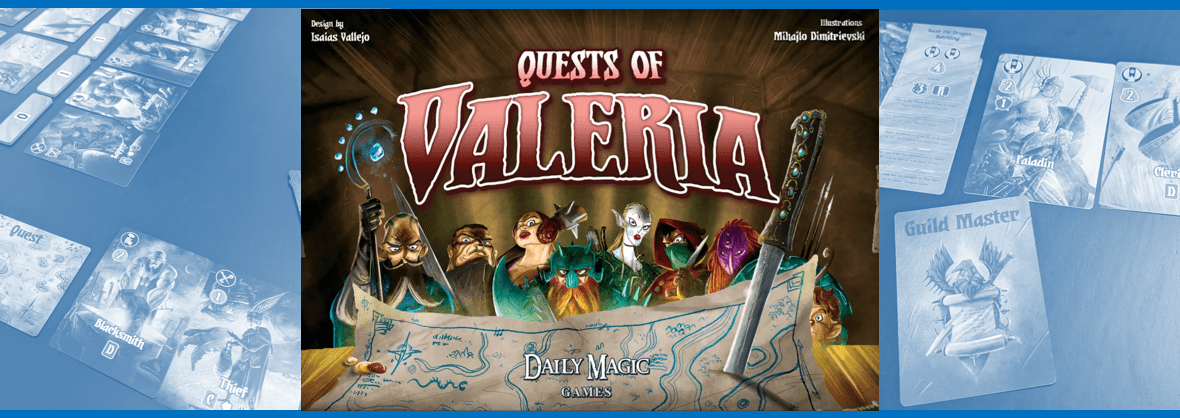
Welcome back to the fantasy land known as Valeria. You are a Guild Master, visiting a tavern to recruit citizens for the sole purpose of completing important quests.
Each turn allows you two actions. You may grab new cards, hire a citizen, reserve a quest, or complete a quest. But while your hand of cards are the potential adventurers you’re looking to hire, they are also the currency you’ll be spending to get things done.
Hand management is key in this race to complete quests and gain the most points.
POINTS OF INTEREST
I am a big fan of the Valeria series from Daily Magic Games. The artwork was the first thing that grabbed my attention years ago (fantasy characters drawn by Mihajlo Dimitrievski always look amazing), but I grew to enjoy each game with it’s own mechanics while all set being in the same world, and all dotted thematically along a timeline.
Among the larger fair, three games were released in the early days, and QUESTS OF VALERIA is one of them. It’s a hand management card drafting game that has you using Citizen cards to complete quests. It will be immediatly familier to you if you’ve played LORDS OF WATERDEEP. The entire game plays like the Quests portion of that classic Worker Placement. Collecting resources to complete quests, getting rewards once you’re done with them. It even has the guild masters for extra end game scoring.
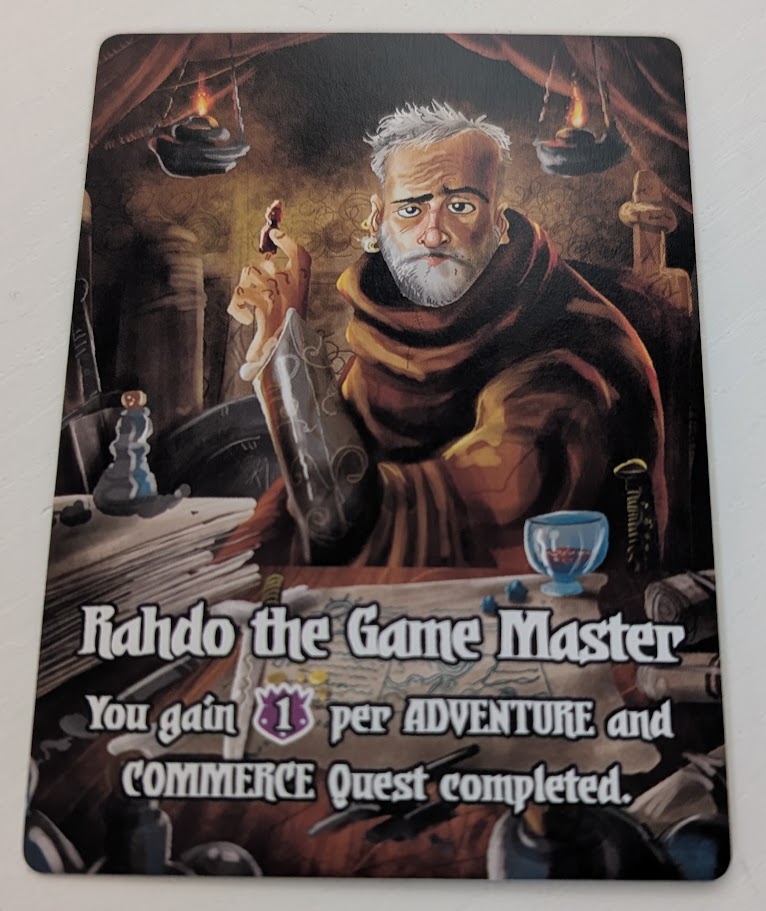
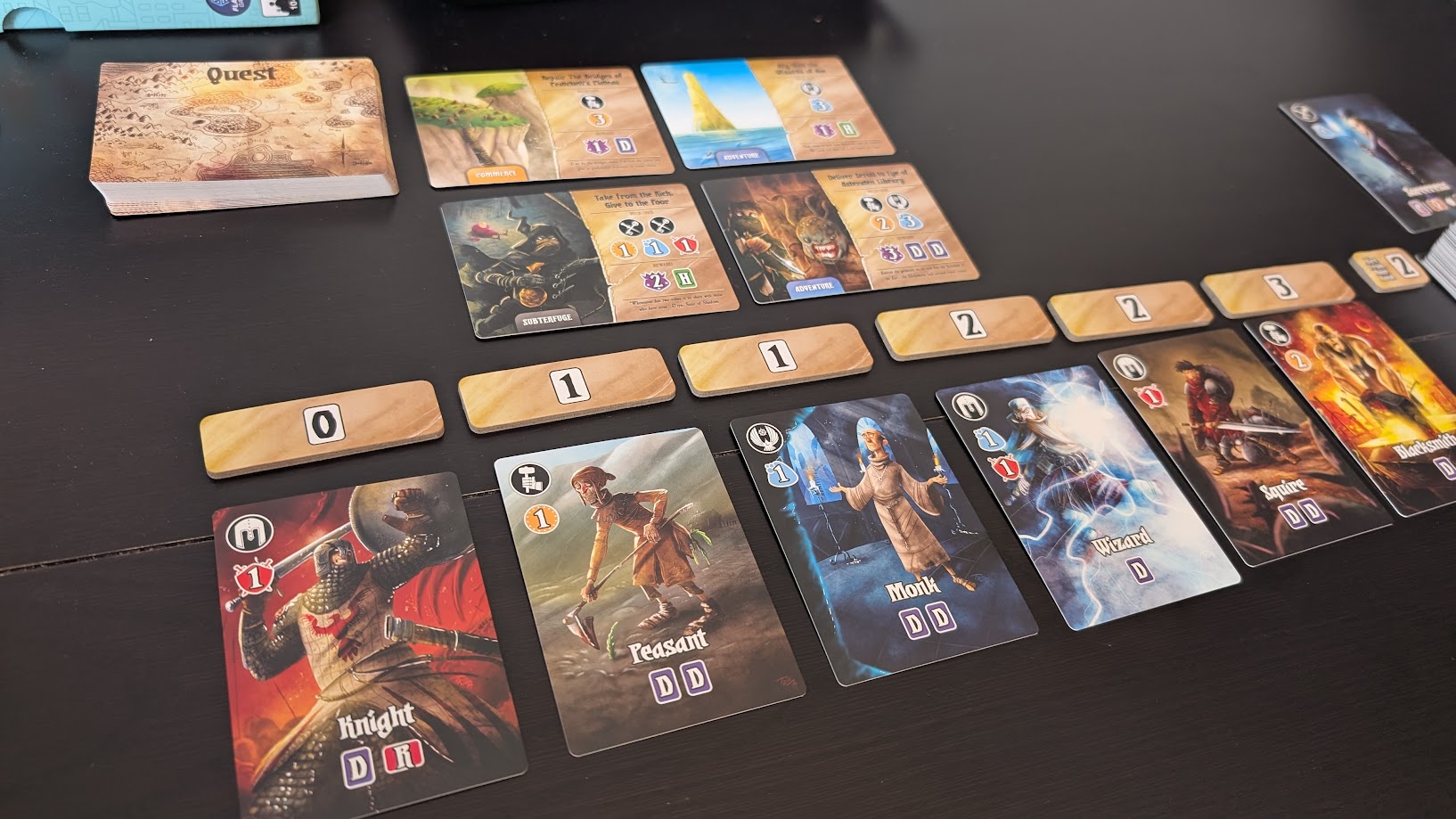
What I really love about it, and what adds a fun and thinky dynamic to this entry, are that the Citizen cards you’re gathering to form the required questing party are also the currency of the game. Cards in the Tavern (a line of cards that form a market) need to be purchased if you want to add them to your Guild. Like most card markets in games, this get more expensive as you go from one end to another, but cards slide down to fill empty spots between turns, meaning that Paladin you want might become affordable soon. If your opponent doesn’t grab them first.
But instead of coin or resources being forked over, you’ll be playing the cards from your hand. So the whole game is choosing the cards you need, and discarding the ones you don’t. Or at least hoping you don’t. It makes the hand management aspect spicy, especially when you’ve drawn a card blind from the deck and wish you could hire from your hand (something you can also do as an action) but you need to get rid of it instead to pay for something else. It forces you to not get attached to your Citizens, and to work out the most efficent ones to add into your Guild.

Of course, those that join your Guild don’t hang around forever. Above the market are quest cards (4 in a 2-player game, 6 in the other player counts) and they all have criteria that need to be fullfilled by a questing party. But when that quest is completed, the Citizens job is done. You only hired them for a single quest after all. So now you need to gather a new band of potential heroes from the Rogues, Mercenaries, Monks and others fantasy stereotypes that frequent the Gutrot Tavern.
The game ends when someone completes their fifth quest, so it becomes a race to efficently complete quests before your opponent(s). But, being one Quest down doesn’t mean you’re out of the game. The simpler Quests don’t offer much in the way of points, and I’ve triggered the end game before only to lose by a lower final score. It means that it’s not over just because someone gets to five first, and it’ll make you think harder over which Quests to complete.
On a normal turn you are lmited to two actions. This is mitiagtyed by the Hire Power, an extra action that almost all of the the Citizen cards have on them. Hire a Citizen into your Guild and then use their Hire Power to take an extra action, usually one of the main. These canm be free, or maybe come at the cost of a card or two, but taking more than just two actions on a turn can be big. It really pays to be as efficent as possible on your turns and do as much as possible. If you plan well, you can manage some big turns.
Most of the games in the Valeria series are big box affairs, so something nice about QUESTS OF VALERIA (as well as it’s small box brethren, VILLAGES OF VALERIA and CORSAIRS OF VALERIA, is that the smaller box size and primarily card based components means it is great for taking a piece of Valeria away with you on your travels. With just a line of market cards having the biggest footprint of the game, it’s fairly easy to set this up and play with limited table space.
These Hire Powers let you take one of the four main actions again, either for free, or at a small cost. It’s when you utilise these abilites that you’ll have a leg up on your opponet, and can make planning turns a lot of fun.
ROOM FOR IMPROVEMENT
QUESTS OF VALERIA is a game that uses icons for everything. The only text on the Citizen cards are the names of the characters. The beauty of this game being part of a series is that icons travel from game to game. So if you’ve played a single Valeria game, you’ll immediately be familiar with the icons used for Strength, Magic, Coin, Points, and the four Guilds.
Unfortunately, Quests has a few more icons that don’t show up in other games, and it took us a few plays before we started to click with the varity of them that can trigger on cards. These mostly revolve around the cards themselves (being a game with a card based economy) and you’ll have to look at a specific page of the manual for your first few games. While it’s not game breaking, it can make your first few games slower. There are reference cards to aid in this, but they only have the individual icons listed, meaning you’ll have to pick out several and almost ‘translate’ what your Citizen card actually does in the moment, potentially slowing things down. It could have been alleviate with text on the cards, but this is something the series shys away from.
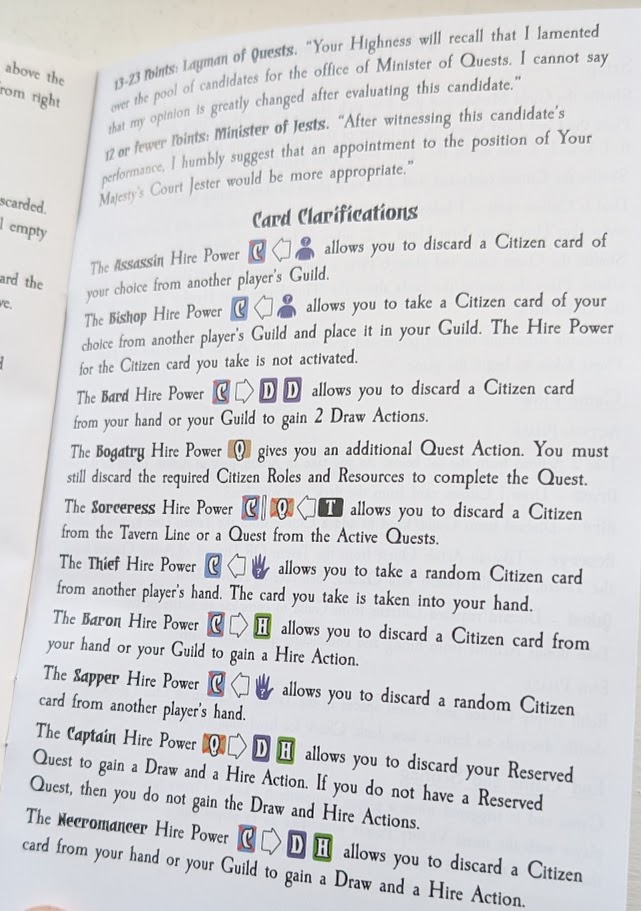
Something else that the game takes from the Quests part of LORDS OF WATERDEEP is the meanness. This game has take-that elements, with comes cards like the Assassin and Thief stealing cards from other players. If you don’t like that mechanic in your games then it might be enough to put you off ‘Quests’. While it’s not a big deal, and can be avoided if you want by always using those specific cards to pay for other things, you can easily have cards from your hand, or worse, your Guild, taken at inconvenient moments.
It’s not a big downer, but the game overall can be quite a tight race (usually only one quest card in it), so having another player interfer with your cards can set you back more than you’d like.
EXTRA CONTENT?
While similar in many ways to VILLAGES OF VALRIA (small box, primarily card based), Quests has no expansions what so ever. And it doesn’t really need them. The game works pretty well as a bite sized entry.
FOR 2-PLAYERS?
The game plays best at 2-player because it reduces the down time between turns. The market flows well enough that it doesn’t need more players to cycle the deck.
| – – CONCLUSION – – A great bite sized entry into the Valeria series of games. It’s a race to five quests as players use cards to get more cards, all while trying to trigger extra actions as efficiently as possible. It comes with a little take that, and feels more icon heavy than other Valeria games, but it’s quick to teach and doesn’t outstay it’s welcome. |

Review #0222
 Always Play Blue