| PLAYERS | TIME | DESIGNER | ARTIST | PUBLISHER |
|---|---|---|---|---|
| 1-4 | 120 – 240 mins | Cornelius Cremin Pawel Mazur Dirk Sommer | Igor Desic Bartek Fedyczak Dirk Sommer | Nemesis Games |

METHOD
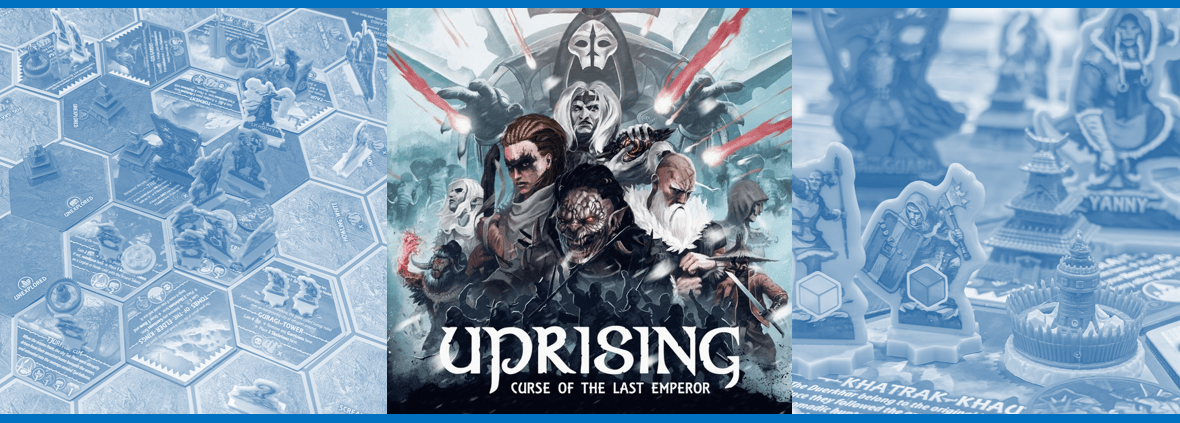
In a dark, end of world, fantasy setting, UPRISING: CURSE OF THE LAST EMPEROR takes players up against an ailing Empire at the centre of the kingdom and a rising Horde of chaos that encrouches from the edges of the wasteland.
This is a 4x game, but not as you’re used to. It’s co-op goodness wrapped in beautiful art and components. It’s a game where your clans must stratigically work together to take out enemies on two fronts. Assist each other in interesting ways, using the knowledge you share to plan turns, to pick off enemies, and to control the map.
And while having two enemy forces to go up against might seem daunting . . . they’re not best buddies and will be going for each other almost as much as they’ll be gunning for you.
Get your armies in place, lead with your chosen hero, and roll some damn dice.
The Uprising begins here!
POINTS OF INTEREST
I’ll be open and honest from the start; I absolutely love this game.
I was drawn in years ago during it’s first Kickstarter campaign by the gorgeous components and dark fantasy artwork. When it arrived 15 months later, I was blown away by the amount of content contained within the base game box and it’s first expansion. By that stage in the hobby, it was the biggest game I owned.
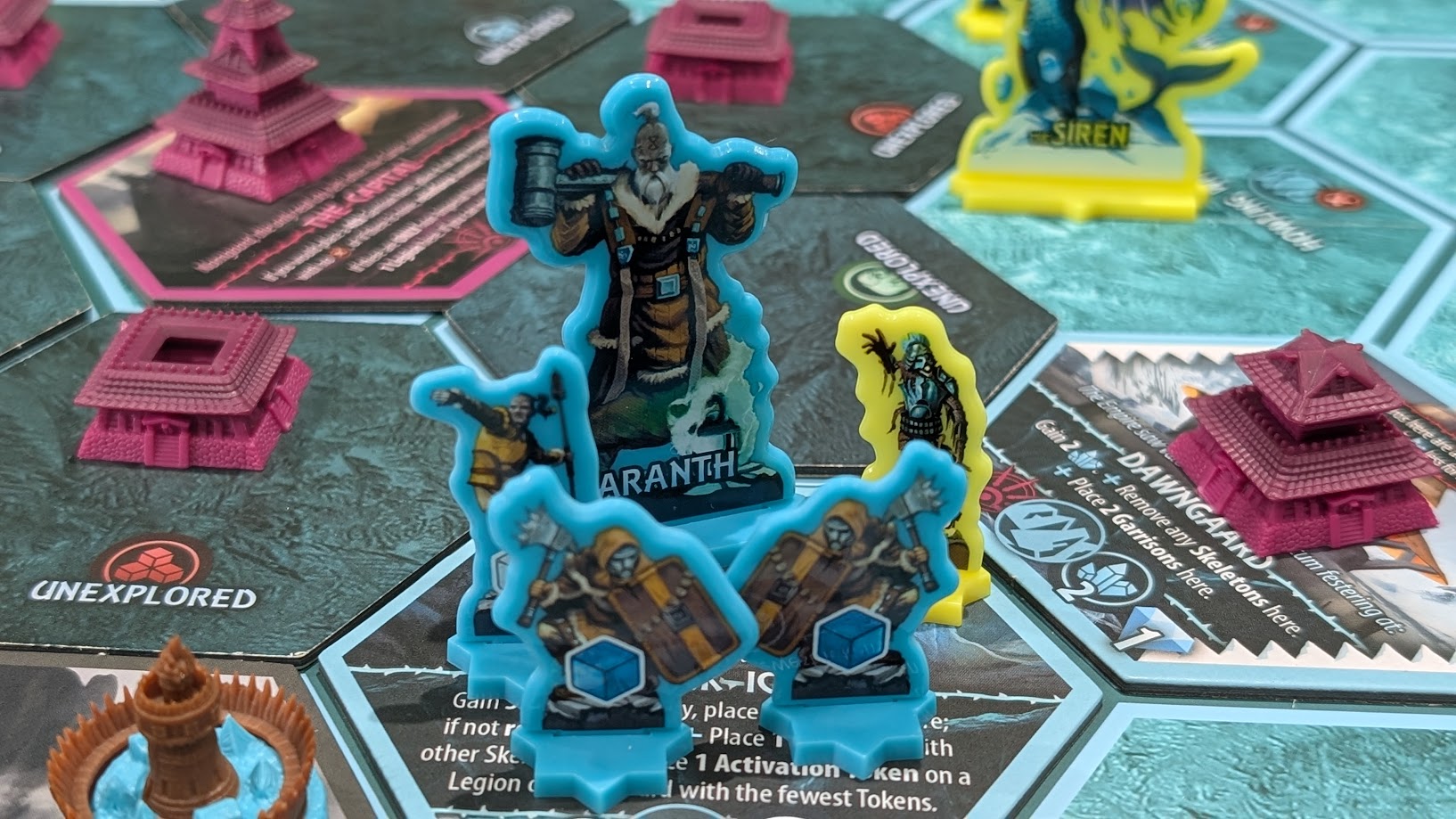
And while a lot of other games that I passed by on were overflowing with minis like ANKH and the ZOMBIECIDE games (handfuls of plastic that I’d never get painting and looking nice, not with all the will in the world), here we had brightly coloured acrillic standees. Here the heroes and their armies were already captivating enough, immediately striking a presence on the battlefield right out of the box.
The game would look nice and I didn’t have to do anything else to it.
Beyond that is the miriad of cards, tiles, dice, and wooden counters. The box is simply overflowing with everything to give players an epic experience. It must be daunting to set up and learn, rtight?

Actually, no. While it’s not simple like learning UNO out of the box, the instruction manual (spiral bound to decrease the table space it takes up) is well layed out, covers pretty much everything you’ll need to know in a coherent way, and even comes with a list of regularly forgotten rules in the back.
And there’s a cherry on top. Because you can know your gameplay options all day long, but if you don’t know the order to carry out phases and actions, it can all feel somewhat overwhelming.
Nemesis Games have you covered. Along the side of one of the boards (of which there are three!), is a list of every phase and what it requires for you to do. A perfect step-by-step guide to take you through your 2-4 chapter playthrough. It makes the game so smooth and it prevents small tasks from being missed out.
It’s like a preflight check list for each round.
Of course, playing something correctly is meaningless if the thing you’re playing isn’t fun. So isn’t it great that the gameplay of UPRISING: CURSE OF THE LAST EMPEROR itself is so darned good.
While a number of steps on that round guide are merely admin, like refreshing cards, scoring points, and bringing out a new chapter card to alter the game state (usually for the worse), the main gameplay you’ll be getting stuck into will boil down to a small number of fun activities.
You’ll be building Havens and troops so as to buff out your forces. These cost precious resources that you’ve stacked out and earned from the previous round. What’s key here is that this is the only stage in a chapter where you’ll be able to build up your army and Haven defenses. Once you’re through the build phase, it’s full steam ahead. And you’ll feel those loses because it will be a while before you can replace them. This adds so much tension to the actions phase because every troop movement and attack needs to be well thought out. It’s always a risk, so make it count.
So after you’ve prepared yourself, you’ll be heading into the actions phase; the meat and bone of the game. Here, each player has eight tokens they can use, one at a time, to select actions. These range from moving heroes and troops around, rolling certain dice to complete quest cards, building out those Havens to extend your clans reach, and maybe gathering a little salt if you need it.
Your hero will do all of the exploring. They have almost zero movement restrictions when it comes to blocked tiles. They slide across, flip a hex tile over, and reveal the bad news of what is waiting there. Only when you know what is waiting can you order you troops into a region and potentially start a ruckass.
Then, once all the good guys are done with their actions, it’s time for the bad guys to do their thing.
The game has very clear rules on how the Horde and Imperial forces work. It’s super simple to move them towards their target (which may or may not be you) and each of these evil factions has it’s own feeling with how they work and dominiate the board.
The demonic horde slowly move towards the capital in the centre of the map, leaving behind curses that decimate the land and make hex tiles useless to all.
The Imperial forces, on the other hand, send their best agents to hunt you down. They act like sharks in the water, each round seeing their standees move one step closer to stomping on your little havens. And each one has a bunch of abilities that make them feel different from each other. The design of these villains is top notch, with the only real thing that they have in common with each other is that I fear them all equally.
So, we’ve had a lot of building and stalking around the map. But what happens when two teams square off of on a single hex? Well, whether it is a bad team and you, or both bad teams coming together, it’s now that we get to roll a bunch of awseome dice.
For our heores, the troop standees are each marked with which dice they bring to the battle. It’s immedialy clear what they contribute without even having to look down at your board. And to take things a little further, there is a card for players that show you the dice outcomes for each of the six different dice colours. Some are more attack, others more defence, and a few have lightning bolts, which are both good and bad for you, depending on who rolled them.
Combat is super quick in UPRISING: CURSE OF THE LAST EMPEROR. Gather the dice you need, roll them, compare results. Each skull is a hit, each shield is a block. Blanks are poo. Meanwhile, lighning bolts let you do one of two things; either cancel an opponents shield (noice) or use an ability on a revealed Druid card.
Each chapter sees a new Druid card revealed, and these remain for the rest of the game. These cards will allow you to do powerful moves in combats like cancelling an opponents skulls once per fight or letting a dead troop fight on for this one battle as a sort of ghost warrior.
As you take hits you’ll remove troops to the enemy graveyards. As the enemy takes hits, they’ll grow weaker and weaker, rolling less effective dice until you wipe the out.
At their highest level, these epic villains can feel unstoppable. But the right use of items, allies, and luck can bring them down and turn the tables so that you suddenly feel like the stongest character on the board chasing cockroaches away.
It can’t express how much I enjoy the combat in this game. It’s devoid of charts and tables to callculate odds, damage, and defense. You can see at a glance what is about to happen and what you need to roll. The aftermath is smooth. And it you have anything left over, you just go again until you can’t any more. It can be an AP decision to take the plunge into a fight, but once you’re there, it’s a rollercoaster to the end, whatever the final result.
So does the game ever get boring? Not at all. Not only is it two to four hours well spent, whether you win or lose (and you will lose. A lot), it is never bogged down or repetative. And what’s more, it has a whole bunch of variable set up for gameplay and game difficulty.
Seriously, there are a bunch of ways to tweak the difficulty here. The manual has a host of what amount to house rules for set up, even before you get to the advanced cards that can litter every deck. There is so much to tweak here until you find the settings that you enjoy the most. It’s fantastic.
And it’s co-op.
ROOM FOR IMPROVEMENT
This is tough for me.
In terms of gameplay and mechanics, there is pretty much nothing I would change. And if I would want tweaks to how things work, perhaps later down the line, there is plenty of variablity for more to alter and amend what I’m doing.
As for cosmetic changes, most of these are little things, silly things, that in no way ruin the experience. Sure, the card stock is a little annoying and makes it hard to thumb through items and quest cards, but this bad boy was sleeved the same day I unboxed it.
Could the insert have been better? Sure. A few things need putting away in odd places (the ‘dice’ section is cleartly marked but not big enough to hold a full set of dice) and there are two resource trays when one is enough to hold all the tokens. I use the second to hold the garrison parts instead. But it does all go somewhere without being a puzzle. It all works, even if it’s only 80% perfect. Thats’ still better than a lot of game inserts.
I guess my biggest thing that I’d have liked to change are the faction cards. While there is some asymmetry involced in which of the two characters you choose from a clan, a lot of the cards are duplicated across the two decks. I feel like either each character deck should have been a lot more asymmetric, or some cards were just shared across characters.
But I’m picking at little things here. And while I know a game can never be 100% perfect, this game does everything it sets out to accomplish and it does it all above average. It’s pretty damn close.
EXTRA CONTENT?
Heck yeah.
When the base game was released, the ‘Arch-Nemesis‘ expansion was already complete too. It contains four new clans to try out and adds the Arch-Nemesis themselves; bigger and badder boss enemies to bring in on the final chapter. You know; for all you Uprising sadists out there. We’ve dabbled with the clans which mix in nicely, but we’ve not gone with the meanies. Yet.
The ‘Titans Of The First Age‘ expansion brings in two more factions to play as, each providing a nice bit of complexity and some interesting new mechanics. It also adds a bunch of modules to assist in making the game easier or more difficult. This includes some beautiful new dice, a way to take rerolls, and of course, more baddies. This game already has fantastic customisation when it comes to setup and gameplay, but this box provides even more. Plus the two new factions are super interesting to play as.
Outside of that there are a few small box card decks that add a few extra things to your clans, and there is the upcoming big box storage and true solo mode coming to crowdfunding soon.
FOR 2-PLAYERS?
While I wouldn’t hesitate to play this at higher counts (and maybe solo), we have a great time at just 2-player without ever feeling like we’re missing anything. We’ve won and lost at this count, but never felt under or overpowered. We have enough space on the map to do our own thing without feeling like we’re getting in each others way, but at the same time, we never feel like we’re too far apart that we become isolated and swamped by the enemy. If this was a 2-player only game, I’d be perfectly happy with it.
| – – CONCLUSION – – Sometimes you buy a game, hoping for it to overwhelm you and keep calling you back but find that the final product doesn’t meet the version you had in your head. UPRISING: CURSE OF THE LAST EMPEROR is absolutley a gem of a game that has exceeded my expectations since day one. Even when we’re clearly losing, there’s always something to fight for and some possible way back. The table can look messy to the untrained eye when you half way through a game, yet for players it runs so smoothly and never runs out of steam across a 3+ hour game. If I could only keep hold of a handful of games, this would be one of them. |

Review #0212
 Always Play Blue