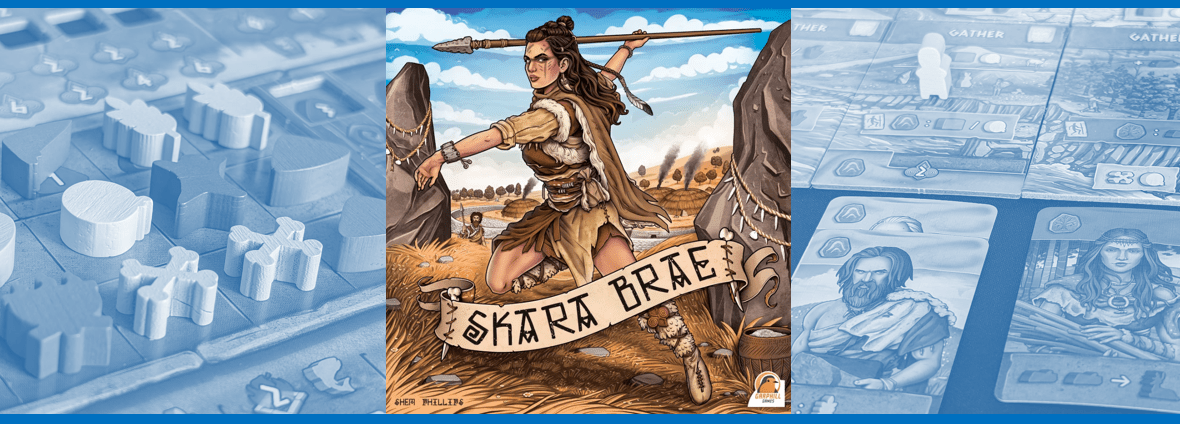
| PLAYERS | TIME | DESIGNER | ARTIST | PUBLISHER |
|---|---|---|---|---|
| 1-4 | 45-60 mins | Shem Phillips | Sam Phillips | Garphill Games |

METHOD
SKARA BRAE is all about sheltering and feeding your people. It’s that part of AGRICOLA, but on steroids.
Each turn you’ll be drafting a new villager, using their specialty to gain something, and then using your slowly growing pool of workers to carry out various actions around your village.
But, where a lot of resource games might have somewhere between 3-5 different resources to gather and manipulate, SKARA BRAE dials it up to 11. Well, 16 actually.
POINTS OF INTEREST
This game is another entry in Garphill Game’s ‘Ancient Anthology‘ series. Seperate from the Medieval Trilogies, this series sees a swap out of artist, and has the themes jump around a little more in history.
For this entry we’re travelling back about 5000 years to toil around as a community on the Orkney Islands (off the coast of Northern Scotland). They had a practice of using waste products, things that you and I might just bin nowadays, and making large mounds that could be dug into and used generations later as homes.
This informs greatly on the sort of resource management you’ll be doing. A common mechanic in resource management games sees you gathering resources and then using resource A and resource B to build a house, for example. In SKARA BRAE, you can do something similar (combining certain resources will upgrade your village tiles, for example), but preparing livestock to feed you villagers produces more than just the food itself.
Storage is another key element in this game, and it’s one that puts an interesting limitation on what you gather and produce. Of course, it’s a lose limitation, but one that punishes you with negative points if you push too hard. Which I usually do because I’m a hoarder.
Each player board has a storage area made of 33 slots. This is where you place what you have gathered, be it corn, stone, fish, or deer. Some actions like upgrading will see you remove the resources and carry out the action. That’s two spaces you’ve just gained back to upgrade a tile. Great.
But your villagers need food four times throughout the game and they are quite picky about how it is prepared. You can’t just look at your board and say “cool, I have three fish and two deer” and expect them to be okay with that. You’ll have to use a cook action at some point to turn raw animal meet into something edible.
And it’s not one for one. Animals have left over parts when they are cooked. A single deer sitting in your storage creates a food (yay) as well as a hide and two bones (yikes). That one slot you emptied now has four items that need a home. Let me help a little with the math; that’s three extra slots you’re now taking up!
It’s not all doom and gloom though. These extra resources you’ve gained aren’t clogging up your storage. They have their own use. Other spaces in your village will take them and put them to good use. But that, my dear reader, is another action.

That’s not to say that all resources are born equal. Midden is that one resource that will get in your way and require extra attention to prevent it getting out of hand.
As you fill your storage area up, a little slider will move from left to right, freeing up more spaces. But, when you remove any resources, it doesn’t automatically go back down again. You have to do that manually. Why is this important? Because, from a few colmumns in, you’ll start gaining Midden at round end. And this stuff takes up valuable slots with a resource that can’t be spent on actions. Thankfully, one action will allow you to remove Midden and/or reduce the slider.
You’d think that this process, this extra work that costs good resources and a worker to carry out, would be best avoided. Keep the space you use low and get by, right? But that will restrict you too much, preventing you from accomplishing anything. You need to open your storage up, all while preparing to clean it up. Or, not. I’ve won the odd game being the only player with negative points caused by my slider.
While resoucre management is the main bedrock of the game, it’s not the main mechanic. The actions themselves are split into two parts; card drafting and worker placement.
At the start of each of the four rounds, rows of villagers will be layed out and lined up, like some kind of talent agency auction. But it won’t just be the current turns cards. You’ll see all three drafts rows for the round.
This becomes important because of how the draft is carried out. A little board with player tokens is off to one side. When the first player drafts a card, they move their token to another spot which is effectively turn order for the next draft. But now they are going last. This would appear to produce a snake draft, not good for the players locked in the middle. Yet there is another choice on your turn; you can pass, placing your token on a seperate spot, and waiting to the end of the turn to draft last.
Why the heck would you do this? Well, as I mentioned, you can see all three card rows for the round. Imaging if you weren’t too bothered by the cards in that first row, but spotted something noice in row two. Congratulations, you’ve just taken first pick in the next turn, guaranteeing that awesome card.
I like this mechanic. I adds a little bit of thought and planning into what would have been a very boring draft phase. Sure, you could gamble that the card you really want is still there on your next turn if you were to go second, third, or fourth. What you want might not be what others need during this round. But it’s nice to have that control over it, to take away that risk and anxiety. Your nails will be saved from any nevous nibbling.
So what does this villager do for you once you welcome them with open arms? Not much really. They help gather some resources, doing better if you have more of the same suit already in place (there are four colours of villages to match the four gathering slots on your board). They might have a little bonus or allow you to change some reources. After that they are just an irritating mouth to feed.
Other cards get mixed in too though. Stone knives are great for taking extra resouses from certain actions. Utensils add more cooking points (allowing you to cook more things in a single cook action), and roofs somehow magically cancel out the food request of one villager: in effect, every roof card you have means one less mouth to feed.
All this means that certain cards will be important to you at different points of the game, and it’ll be up to you what you grab and when you grab it.
After drafting comes worker placement. You’ll start with one worker, and gain another each round to a maximum of four. What I like about this is that it happns regardless. No paying resources for it. No players missing out because they couldn’t afford it or a spot was blocked (I’m looking at you, VITICULTURE). Just a slow progression to the game that matches the pace of your requirements.
Round one will see you not having much and not needing much, so a single worker used once over each of the three turns just pootles along for you. But by round four, with many mouths to feed and a couple of tracks to move up for end game scoring, you’ll be using four works over three turns giving you 12 actions, all while probably wishing you had more. It’s a nice element of progression.
And all this resource management and worker placement is simultaneous play which is fantatsic and time saving. It’s the main bulk of the game and would have made it a three hour epic if the whole thing had been completely turn based. Once that card draft is gone, is heads down and off to the races as all players puzzle out their storage to maximize points.
ROOM FOR IMPROVEMENT
Of course it’s this heads down, mulitplayer solitare style that might put some players off. Other than that semi-cutthroat interaction with card drafting which could see decisions seriously effecting other players (whether you mean to or not), it’s all about your eyes on your own board and everyine waiting for the most AP player to be done.
I don’t have an issue with it myself. These types of games can be very enjoyable as you focus on your own puzzle, only occasionaly interacting with those pesky opponents sat across from you.
However, if this is something you don’t enjoy, it will only be exacerbated by those later, longer rounds. Waiting for someone to take a single worker action is one thing, but four actions towards end game when storage solutions get super crunchy, can and will drag things out.
The number of resources could also be quite off putting for players not use to this level of component management. The board is well laid out wirth icon reminders for what comes from what, but it’s still easy to forget what resources do what without having to look over constant reminders.
While each village has the same nine action locations, each player will draft a tenth at the start of the game. This means that you’ll be used to the main nine after a couple of plays but might sturggle to use you extra addition. Or maybe you’ll forget about it during them game, which sometimes happens to me until it’s too late.
I like that a small level of asymmetry was added to the game, but I feel that some abilities are more useful than others
EXTRA CONTENT?
No expansions currently, though I did get the KS Promo Special Action tiles that gave us two more locations to shuffle in with the eight that came with the box.
FOR 2-PLAYERS?
2-player games of SKARA BRAE work great for the most part. With a game that is 90% doing your own thing and having simultaneous play, it doesn’t alter the play time too much.
However, the draft system take a little bit of a hit in this player count. A dummy player is cast into the stack with the lead player making a choice when it’s the dummys turn to remove a card from the draft. This simulates card removel before the player going last so as to remove an extra card and reduce choice, and I’m fine with that.
The issue I have with it is that you can quickly get stuck in a rut. If we sandwich the dummy player then palyer one picks a card, removes a card, and leave player 2 with only two cards. If the dummy player is third then this affect on the second player doesn’t exist, and they lose this draft blocking ability while player one gets it every other turn.
I can see why it had to be done, but it just ends up in a repetive cycle where you might want to pass to get a specific card next turn, but it’ll put you in a bad spot until you pass again on the opposite turn to get out of being stuck in the middle.
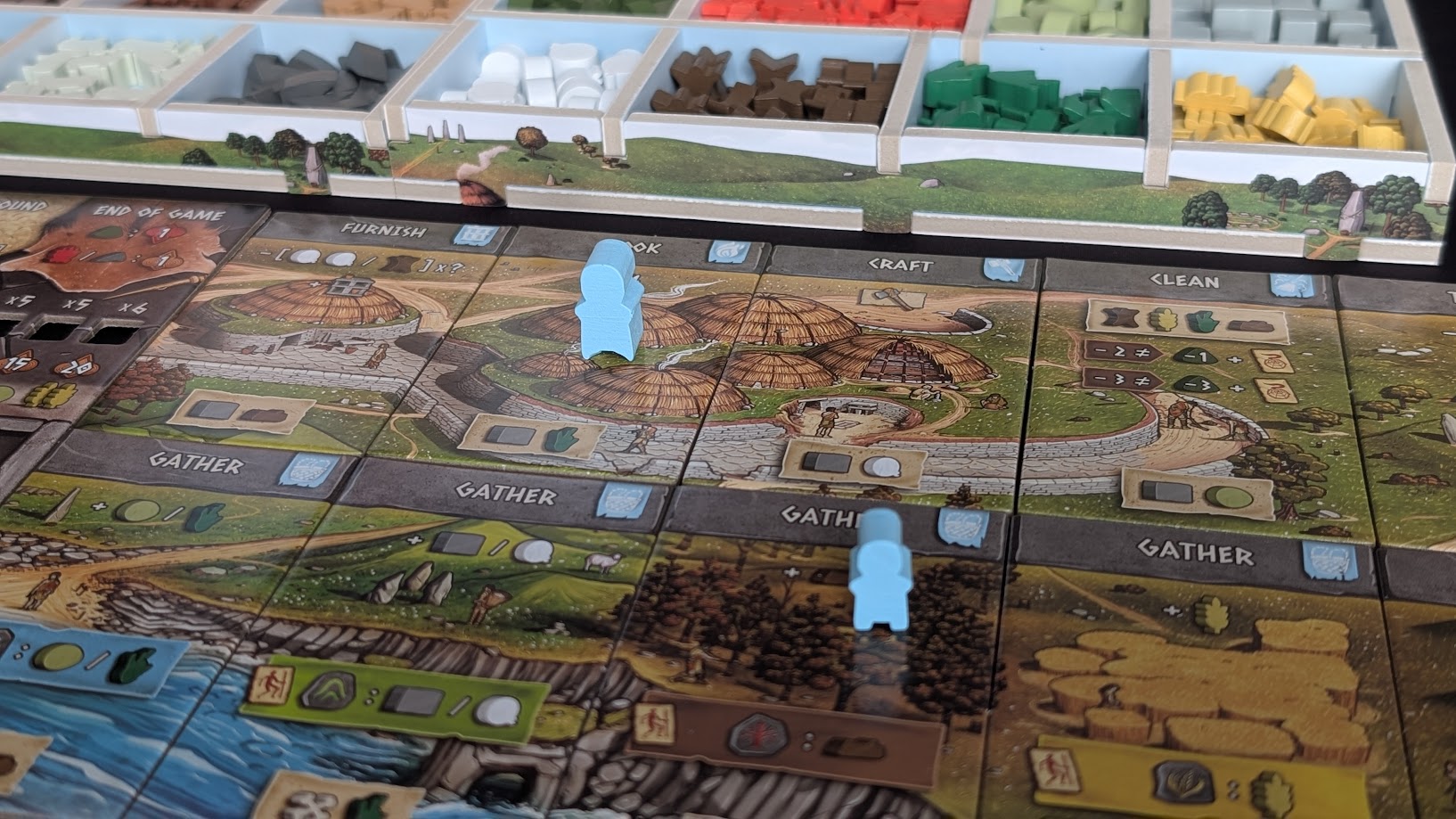
| – – CONCLUSION – – SKARA BRAE is a great little resource management game that comes with a slew of resource components and some fantastic Sam Phillips artwork. It’s another stand out addition to the ‘Ancient Anthology’ series that made me glad I stepped outside of the Medieval Trilogies to see what else Garphill Games did and I’m not disappointed. A small hiccup with the 2-player draft doesn’t take away from this interesting puzzle of a game that has a lot of layers to explore. |

Review #0210
 Always Play Blue